Eugene requires EPDs for city concrete mixes, advances low‑carbon materials
Loading...
Summary
City of Eugene staff told a committee the city now requires Environmental Product Declarations for concrete used on capital projects, and described existing low‑carbon measures — warm‑mix asphalt, 35% recycled asphalt content and a 30% minimum SCM requirement — and ongoing pilots to increase SCMs and monitor durability.
City of Eugene public‑works staff told a committee that the city is requiring Environmental Product Declarations (EPDs) for concrete used on its capital projects and is pursuing additional low‑carbon material pilots.
Rachel Vicunas, one of the principal civil engineers on the city’s capital projects team, said the city has already taken several steps to reduce embodied carbon in construction: adopting warm‑mix asphalt roughly 10–15 years ago, requiring 35% recycled asphalt materials in base and wearing courses, and mandating at least 30% supplementary cementitious materials (SCMs) in concrete mixes. "We're getting these EPDs are now a requirement for all of our concrete mixes on our capital projects," Vicunas said during the presentation.
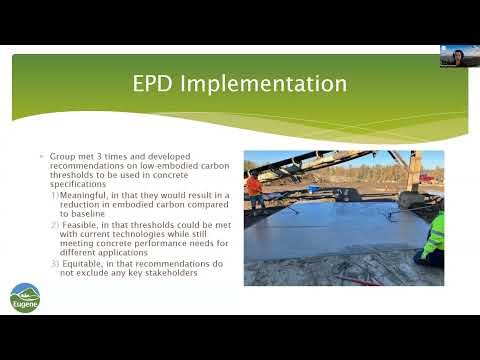
EPDs are third‑party verified documents that report a product’s life‑cycle environmental impacts. Vicunas said the city convened a greenhouse‑gas threshold committee in 2023 that included city staff, Lane County materials‑testing lab staff and local suppliers Riverbend and Knife River; the group used National Ready Mixed Concrete Association (NRMCA) Pacific Northwest benchmarks to set maximum global‑warming‑potential thresholds for concrete. Using Riverbend’s EPD as an example, Vicunas showed a 3,000‑psi mix with a reported global‑warming potential around 170 CO2e per cubic yard, below the city threshold of 200 CO2e per cubic yard.
Staff said suppliers submit EPDs as part of an approved materials list that the city updates regularly. Katie Marwitz, another principal civil engineer, cautioned that small, homeowner‑scale deliveries can be harder to supply with specialized mixes now required on city projects: "If I were to just call and say, hey, I want to do some concrete at my house... the suppliers are not doing this" at that scale yet, she said. Commissioners also raised questions about cure time and long‑term durability with higher SCM levels; Marwitz said acceptance testing focuses on strength and that higher SCM mixes can take longer to reach that strength, though they have met test requirements so far.
Staff noted lifecycle and sourcing concerns are addressed through EPD reporting: if a supplier brings SCMs from distant sources, that should be reflected in the EPD and therefore in the mix’s compliance measurement. Vicunas said the requirement was adopted after the committee’s 2023 work, with suppliers given notice and the city implementing the EPD requirement beginning in 2025. She told commissioners the project team will continue pilot pours with higher SCMs, monitor performance, and explore additional low‑carbon binders and silicate‑based alternatives under consideration.
The committee asked about next steps: staff said the goal is to compile recommendations and options for council by around June and to continue supplier engagement and testing. The city recording and presentation slides will be posted publicly.