
Fulton County budget debate centers on court staffing, consent‑decree costs
Get AI-powered insights, summaries, and transcripts
Sign Up Free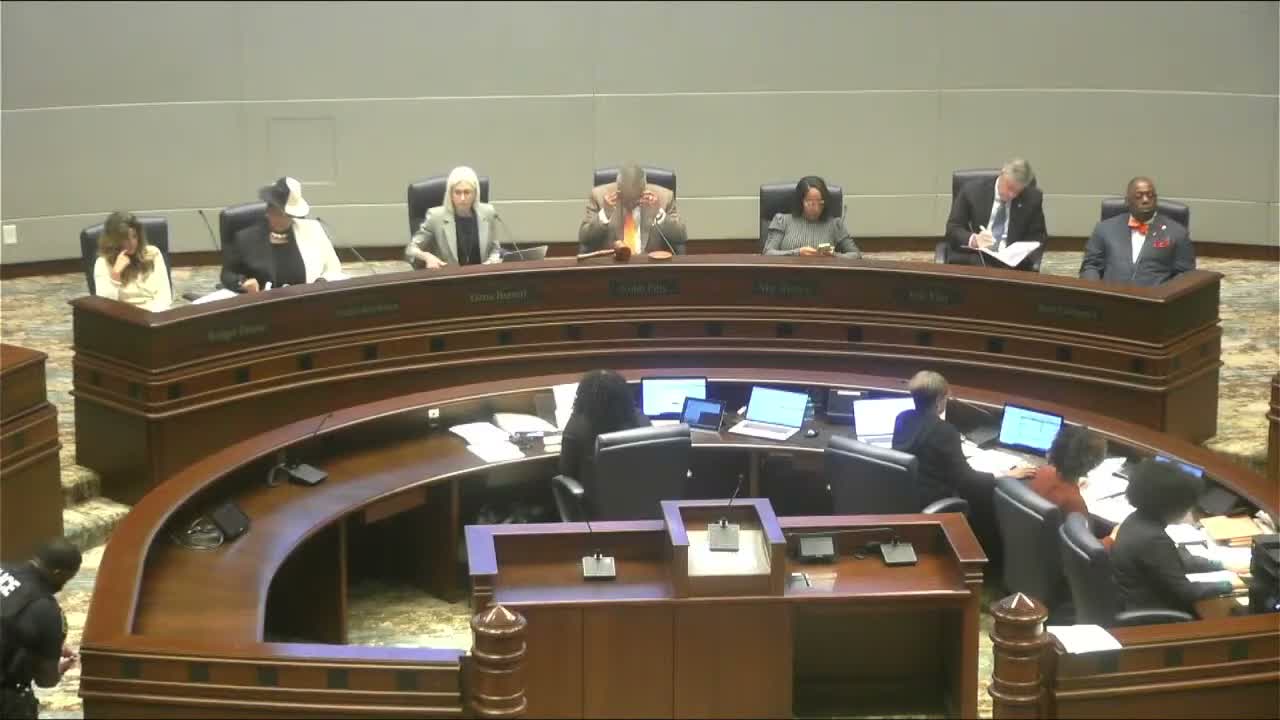
Summary
At a Jan. 7 meeting the Fulton County Board of Commissioners reviewed a revised FY2026 budget that increases spending for federal consent‑decree compliance and funds staff for two new state‑court judges; judges, prosecutors, the public defender and the clerk warned underfunding will worsen backlogs and jail population pressures.
Fulton County commissioners on Wednesday opened a detailed review of the revised fiscal year 2026 budget, focusing on a large increase for consent‑decree compliance and the staffing needed for two newly authorized state‑court judges. County Manager said the county closed 2025 about $20 million better than projected, and the finance team presented a proposed revenue budget of $1,000,100,000 and an expenditures plan of $1,073,700,000 that would support an estimated 9.26 millage rate.
Why it matters: County officials told commissioners funding choices now could determine how quickly new judges can begin clearing backlogs and whether the county meets federal requirements tied to a consent order governing conditions at the Fulton County jail. County staff recommended placing roughly $53 million in a separate consent‑compliance fund to cover intensified staffing and compliance costs.
What was presented: County Manager said "the actuals coming out of 2025 were 20,000,000 better than projected," and CFO Sharon Whitmore gave line‑item detail for revenue and expenditure changes. Whitmore said the revised budget includes additional allocations for elections invoices, a larger consent‑compliance fund and modest departmental enhancements, and projects an ending fund balance of about $179 million (roughly 16.67% of expenditures).
Courtroom staffing dispute: Commissioners heard several hours of testimony from justice‑system officials who argued the managers' staffing assumptions undercount operational needs. Solicitor Gammage told the board the accepted minimum standard across metro courtrooms is "2 prosecutors and 2 assistant public defenders," and warned that giving the two new judges only one solicitor and one public defender each would short‑staff their courtrooms. Chief Judge Jane Morrison, newly appointed to lead state court, described the bench as "a very high volume court, one of the highest volume courts in the Southeast," and urged funding sufficient to operate the new dockets without creating fresh backlogs.
Clerk and defenders describe capacity shortfalls: Donald Talley, clerk of court, told commissioners his office handled roughly "over 400,000 filings" last year and said the clerk's request for 9 additional clerical staff and 5 court reporters is driven by a sustained surge in subsequent filings; he said his office currently has no vacant positions to reassign. A public‑defender representative and other speakers described day‑to‑day impacts in which understaffing delays case scheduling and contributes to longer jail stays.
Board response and next steps: Several commissioners said they broadly support resourcing the courts but asked county management and justice partners to return within two weeks with a concrete reallocation plan or options for prioritized funding. Commissioner Barrett and others asked for a single, comprehensive list of the operational requirements (staffing, equipment, victim‑services positions and other costs) needed for the two new judges to begin functioning at standard levels. The manager agreed to provide options and additional details ahead of the board's next meeting.
What was not decided: Commissioners did not adopt a final budget or change the millage rate at this meeting. Instead they directed staff to return with scenarios that show (a) the cost to fully fund all departmental enhancement requests; (b) a narrower package focused on justice‑system priorities; and (c) recommended reallocations from non‑agency reserves where legally and practically possible.
Voices from the meeting: - "We have been underfunded and understaffed," Solicitor Gammage said, urging that new judges receive full courtroom teams to avoid a backlog. - Chief Judge Jane Morrison said the judges’ staffing requests "come from the experience of your state court bench" and urged the commissioners to trust the bench’s operational assessments. - Clerk Donald Talley emphasized operational limits: "I have the same staff and we're still trying to manage those caseloads. I need some assistance. I'm begging of you."
What to watch: The county manager and finance team will return with detailed reallocation options within two weeks, including a clear cost estimate for fully staffing the two new courtrooms and for the recommended consent‑compliance fund.