
Auditor gives Lewiston schools a clean FY25 opinion; flags transportation and nutrition budget pressures
Get AI-powered insights, summaries, and transcripts
Sign Up Free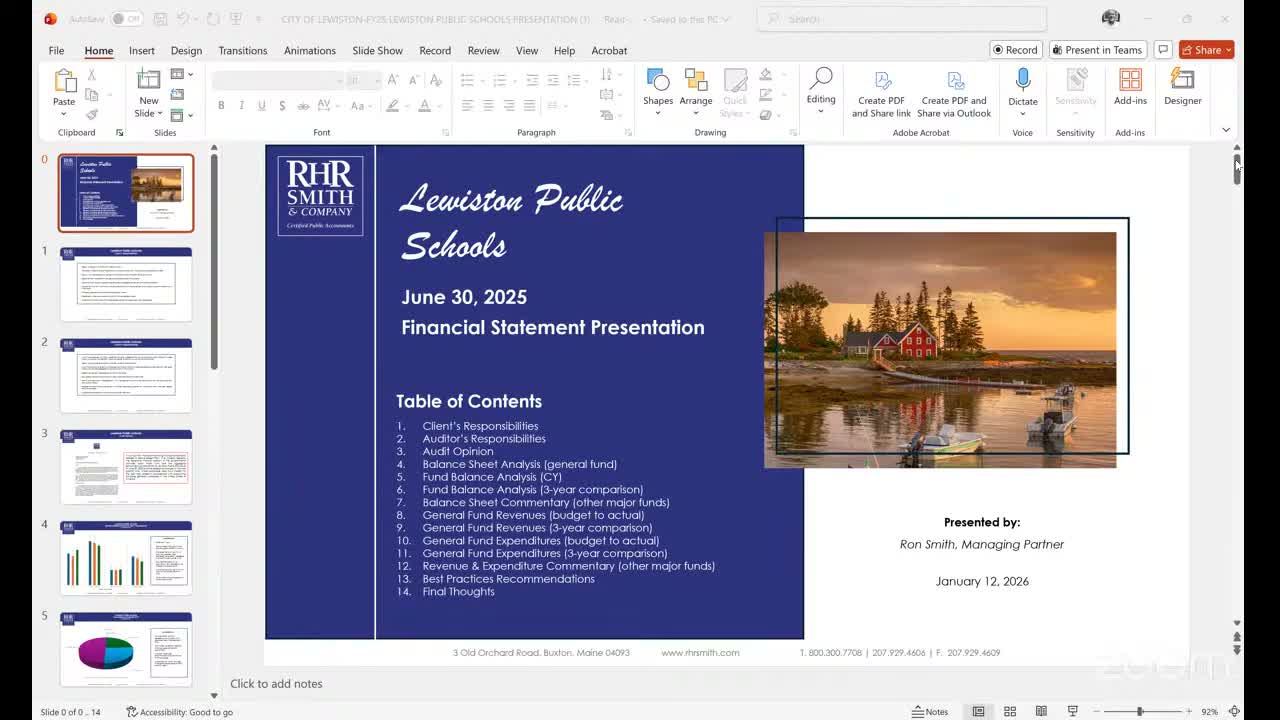
Summary
RHR Smith issued an unmodified (clean) opinion on the Lewiston Public Schools FY25 financial statements, reporting total assets near $24 million and a $14.5 million fund balance; the auditor highlighted transportation overspending and recommended monitoring the school-nutrition budget as federal COVID-era supports phase down.
The outside auditor for Lewiston Public Schools reported a clean, unmodified opinion for fiscal year 2025 and walked the school committee through key fiscal metrics, including assets, liabilities and the district's fund balance.
Ron Smith of RHR Smith told the committee the district held roughly $24 million in total assets, about $21 million of which was pooled at the city level, and liabilities around $9.6 million. The district's fund balance stood at about $14.5 million as of June 30, 2025, with approximately $7.1 million unassigned. Smith said the district expected to use a portion of its carryover when constructing the FY26 budget but that better-than-projected revenues reduced the planned drawdown.
The auditor highlighted two items the committee should monitor: transportation, which exceeded budget by roughly $1.0–$1.3 million in FY25, and school nutrition. Smith said school-nutrition carryover was modest (about $145,000) compared with a roughly $5 million program and warned that as COVID-era federal supports are spent down, food-service programs nationwide are under pressure.
"I'm pleased to report that the school department received our highest opinion, an unmodified opinion as of 06/30/25," Smith said. He described the FY25 audit as "boring" in the auditor's sense — meaning the business office provided complete and accurate documentation — but advised the district to watch nutrition and transportation costs in the coming budget cycle.
The committee asked follow-up questions about federal indirect-cost election under uniform guidance (the 10% de minimis rate) and the tradeoffs of assigning that percentage to the business office versus directing funds to program services; the auditor noted many districts choose not to elect the de minimis rate so more federal funds go to programmatic work.
Ending: The committee will proceed into its upcoming budget work and monitoring of transportation and school-nutrition lines over the next several weeks; the audit presenters offered to provide slides and follow-up materials for the board.