
Consultants tell Seattle committee OEM is under-resourced; recommend clearer authority, training and strategic plan
Get AI-powered insights, summaries, and transcripts
Subscribe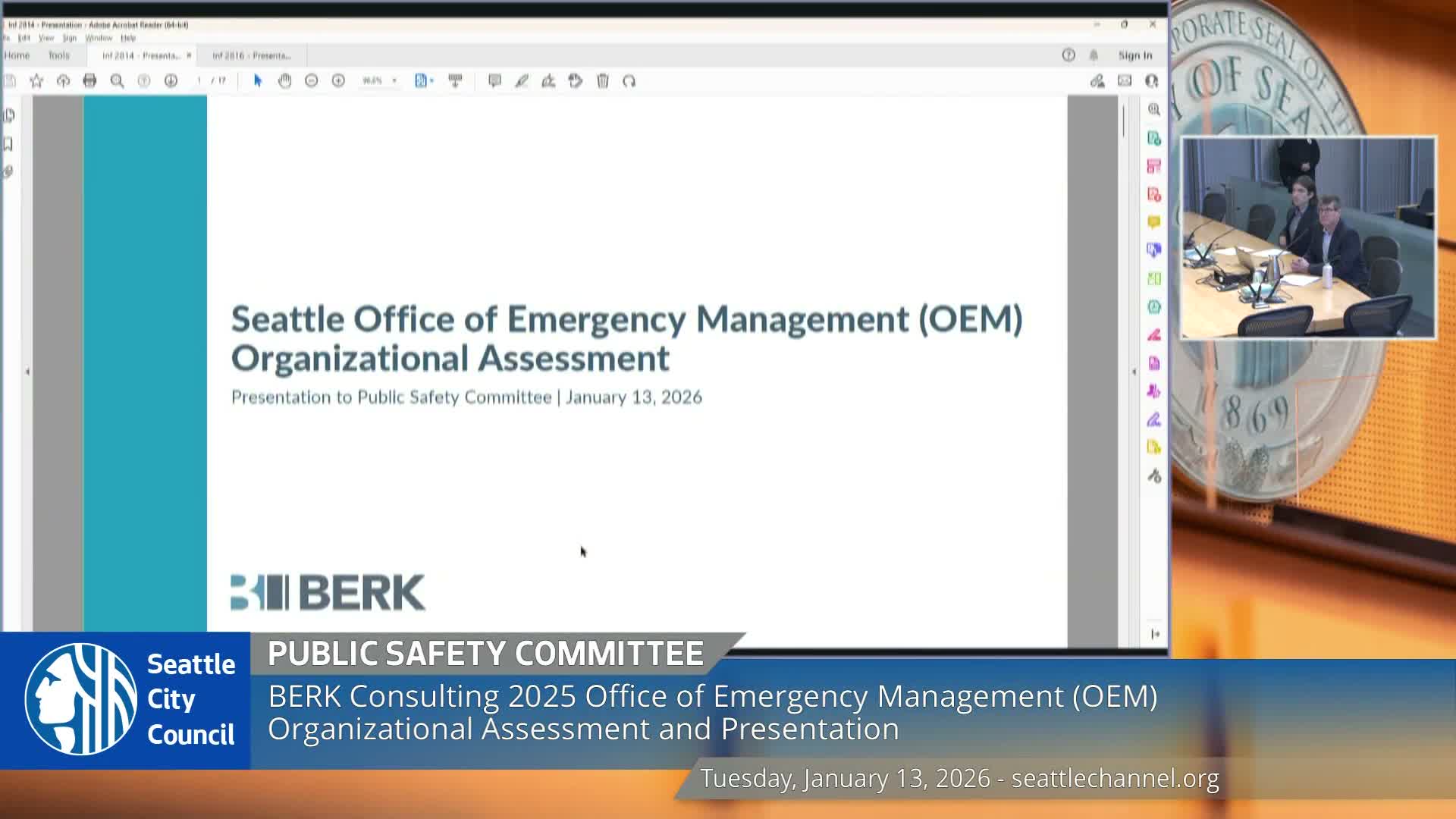
Summary
Burke Consulting and BERC presented a June 2025 organizational assessment finding Seattle’s Office of Emergency Management is small and leveraged, lags peer cities on funding and outreach FTEs, and should keep independent placement while clarifying roles, training requirements, and EOC activation policy.
Burke Consulting and BERC Consulting presented their Office of Emergency Management (OEM) organizational assessment to the Seattle Public Safety Committee on Jan. 13. Consultants Brian Murphy and Oliver Hearn summarized a March 2025 contract and a June 2025 final report that reviewed OEM’s structure, resources, and readiness.
Murphy said the OEM—moved out of the Seattle Police Department in 2020—is accredited by the Emergency Management Accreditation Program and functions primarily as a coordinating office. He described OEM as "a pretty small department" (about 15–20 full-time equivalents) that is leveraged across the city and therefore sensitive to staffing and funding changes.
Hearn summarized the methodology: literature review, stakeholder interviews, and benchmarking against "pure cities" including Denver, Portland, San Francisco and Vancouver, B.C. He gave two headline findings: "Seattle's OEM receives less funding than pure cities, and other organizations had significantly more community outreach and education FTEs." He also said the proposed 2026 budget includes roughly a $1.2 million increase for OEM.
The consultants recommended keeping OEM as an independent department within the mayor's office while improving operational readiness. Specific recommendations included establishing minimum training requirements for non‑OEM city staff, clarifying EOC activation and COOP expectations, developing a RACI matrix to assign roles and KPIs, increasing communications and community‑facing preparedness capacity, and considering whether limited additional authority to obligate resources in emergencies merits further study.
Committee members pushed for detail. Vice Chair Saka asked whether homelessness response should be embedded in OEM; the presenters said homelessness often appears as an emergency response but is not typically a sustained OEM function. Council member Juarez asked which federal grants OEM relies on; consultants named the region's UASI program and planning/mitigation grants as examples but deferred specifics to OEM staff. Council members Rivera and Lynn emphasized updating COOP plans, neighborhood-level recovery hubs, and increased interdepartmental exercises; presenters recommended more tabletop and activation practice.
Murphy and Hearn stressed that some peer cities house additional functions inside OEM (e.g., 911 in San Francisco), which inflates budget and staffing comparisons. They urged the mayor's office and OEM leadership to meet regularly, adopt clear training expectations, and use the emergency management program strategic plan to prioritize near‑term and long‑term organizational development.
The committee did not take formal action on the report during the meeting. Members signaled intent to follow up in later quarters with the administration and OEM staff on budget allocations, training plans, COOP compliance, and the proposed strategic plan.