Folsom unveils 50-year Water Vision with pipeline redundancy, groundwater and Aerojet reuse options
Loading...
Summary
Folsom utilities director presented a final Water Vision report recommending redundancy for the single raw-water pipeline, treatment-plant upgrades, development of nonpotable purple-pipe uses with Aerojet-treated groundwater and phased partnerships to diversify supplies; cost estimates range from planning-level hundreds of thousands to projects in the tens or hundreds of millions.
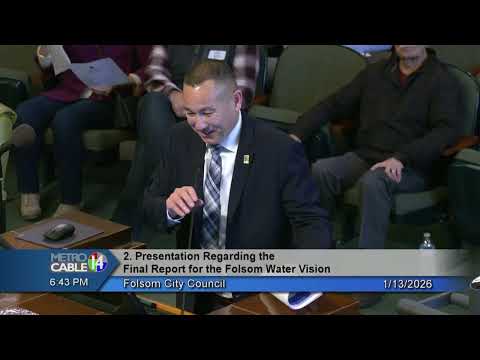
Marcus Yasutaki, Folsom's utilities director, presented the final Folsom Water Vision report to the City Council, describing a 50-year roadmap to secure the city's water supply and reduce vulnerability to a single-point failure.
The plan, compiled from six stakeholder workshops and more than a year of analysis, concludes the city faces three primary vulnerabilities: reliance on a single raw-water pipeline from Folsom Reservoir to the treatment plant, limited redundancy within treatment processes, and sensitivity to low lake levels. "We have 1 single raw water pipeline from Folsom Reservoir to the city's water treatment plant," Yasutaki said, citing a high risk for that single point of failure.
To address those risks the report recommends several portfolios: installing raw-water redundancy (a parallel pipeline or new intake), improving treated-water redundancy inside the plant, and diversifying supplies through groundwater and regional partnerships. The report favors a hybrid portfolio combining surface and groundwater options, including development of the Folsom South Canal intake to preserve contractual rights to deliver water there.
Yasutaki also described nonpotable opportunities: treated groundwater from the Aerojet Rocketdyne facilities could be distributed via a purple-pipe network south of Highway 50 to reduce potable demand. He said the city has an existing agreement with Aerojet Rocketdyne that allows the city to take treated water, but that practical reuse would require plumbing, permit modifications and evaluation of Aerojet's capacity.
The presentation included a phased implementation plan. Near-term work includes feasibility and planning studies (estimated at about $500,000–$1,000,000 for planning/analysis of a new intake) while major construction — for example, a new intake and pipeline — could range into the tens of millions ($25M–$30M for some construction elements) and large diversification programs could scale to $50M–$200M depending on the scope. Yasutaki described a possible multistage approach tied to growth triggers and projected maximum-day demands.
Council members pressed staff about specifics. Council member Kozlowski asked whether planned Easton and Glenborough developments fall within the city's water-service area; Yasutaki said they do and their demands are included in capacity calculations. He and others questioned whether Aerojet's existing treatment and irrigation infrastructure could meet peak nonpotable demand; Yasutaki said further analysis is required and that upgrades or permit changes might be necessary.
On contingency planning the report reaffirms interim measures — floating pumps from the Bureau of Reclamation, emergency connections with neighboring purveyors and trucking water — but frames a parallel pipeline as a priority to reduce long-term risk: "If the raw water pipeline failed between the reservoir and the treatment plant, that's a 100% impact," Yasutaki told the council.
Next steps the director outlined include completing a raw-water alternative intake analysis under contract with Stantec (targeted for late spring or early summer), pursuing feasibility of purple-pipe reuse with Aerojet Rocketdyne, and advancing partnerships with regional agencies such as Golden State Water Company, Sacramento County water agencies, San Juan Water District, Fair Oaks Water District and Citrus Heights Water District. Yasutaki said staff will return with specific project recommendations and cost estimates when analyses are complete.
The council did not vote on any specific capital commitment during the presentation. Yasutaki said that if the city moves to design a new intake or pipeline staff would return with cost estimates and options for funding — including potential rate impacts, bonds or grant assistance.