
Larimer County study finds $114M–$321M in conservative benefits from Climate Smart investments on $45M cost
Get AI-powered insights, summaries, and transcripts
Subscribe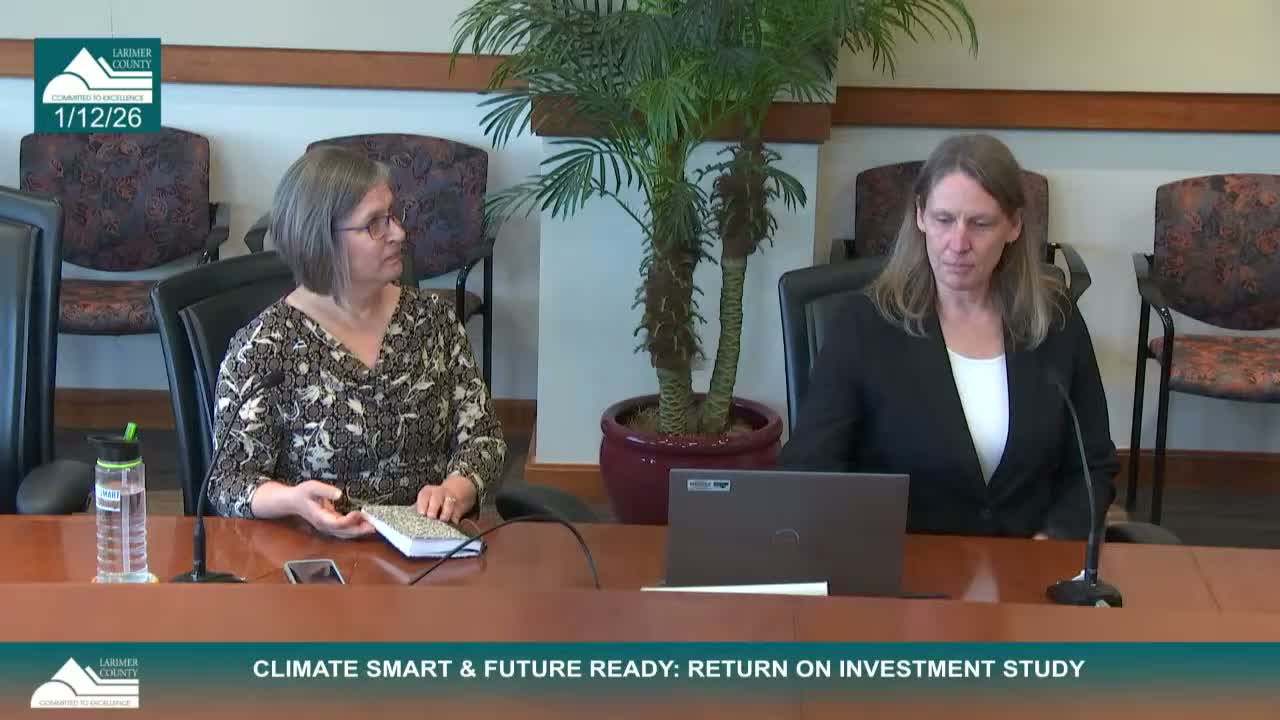
Summary
An eight‑week ROI analysis for Larimer County’s Climate Smart Future Ready portfolio estimates conservative benefits of $114 million to $321 million on $45 million in portfolio costs, with top returns from updated 2024 building codes, open‑lands preservation and wildfire mitigation. Staff emphasized data gaps and directed action teams to improve outcome tracking.
Larimer County commissioners on Jan. 12 heard an initial return‑on‑investment analysis of the Climate Smart Future Ready (CSFR) portfolio that placed conservative portfolio benefits at $114 million to $321 million against $45 million in costs.
Erin Fox, the CSU‑affiliated fellow who completed the eight‑week study, told the Board that the study converted measurable social, health and environmental outcomes into monetary values where possible and used conservative assumptions where direct measurements were unavailable. "The costs at the portfolio level were $45,000,000 but your benefits started at $114,000,000 and may have been as high as $321,000,000," Fox said.
Why it matters: the analysis aims to show whether county‑supported investments in wildfire mitigation, open‑lands preservation, updated building codes, EV charging and other projects deliver public value beyond direct project budgets. Commissioners said the figures could help make the case for continued investment to residents and partners.
Key findings and funding sources
- Portfolio totals: Fox reported $45 million in total program costs. She said volunteers and partners contributed about $4 million in labor; roughly $13 million came from grants and $28 million from the voter‑approved open‑space sales tax.
- Range of benefits: The study produced a conservative lower bound of $114 million in benefits and an upper estimate of $321 million, reflecting uncertainties and long‑term avoided costs.
- Top contributors: Fox identified three high‑return items: adopting the 2024 building codes (about $16 of value per $1 spent, combining county and private owner investments), open‑lands and natural‑resource preservation (roughly $8 per $1), and hazard management/wildfire and flood mitigation (up to $7 per $1, using FEMA ROI factors).
Methods and limits
Fox said the study focused on outcomes that could be plausibly linked to CSFR activities and monetized with defensible sources. Where direct outcome data did not exist, the team used established ROI factors (for example, FEMA studies for hazard grants and EPA values for avoided pollution) or conservative best estimates. She warned the analysis is an initial snapshot: "Not all the benefits could be measured," and many action teams lack before‑and‑after baselines needed to quantify change.
Recommendations and next steps
Fox and staff recommended that action teams shift from tracking activities to tracking direct outcomes, establish baseline metrics at project start, and follow up with impacted community members to measure real effects. Heidi Pruis, the county’s climate and sustainability manager, said champions for each action team will receive the spreadsheet of project calculations at a coordination meeting in the next few weeks and will decide whether to collect additional data.
Commissioner discussion
Commissioners asked whether low‑ROI items such as EV fast chargers should continue to be pursued. Fox said EV charging often shows a lower direct ROI but delivers other benefits—alignment with state goals, increased consumer confidence and potential economic uplift for downtown business districts—and noted state and municipal funding sources make charging infrastructure a relatively secure investment. Staff pointed to updated land‑use code requirements that will make future installations simpler for new construction but noted retrofits of existing buildings remain necessary.
Officials also pressed on funding accounting and scope. Fox said the $45 million total reflects all included costs regardless of source and that the spreadsheet will list each project’s calculations so commissioners and partners can examine how recent grants and open‑space allocations were handled.
Context and caveats
Presenters emphasized the study’s conservative approach and its role as a starting point. County Manager Lorenda Volker praised the defensible methodology and the inclusion of anecdotal, unmeasured benefits in the narrative. Officials referenced larger external studies that estimate even higher payoffs for resilience investments; Fox said broader literature may show larger ratios depending on scope, but this study prioritized defensible, locally sourced estimates.
What happens next
Action team champions will review the findings in coming weeks and determine whether to adapt tracking methods. Staff suggested coupling a future ROI update with a greenhouse‑gas inventory refresh near the program’s mid‑point so the county can measure progress as implementation matures. The Board adjourned at 11:52 a.m.