
City of Oxnard outlines housing pipeline, backlog reduction and March go‑live for new permitting system
Get AI-powered insights, summaries, and transcripts
Subscribe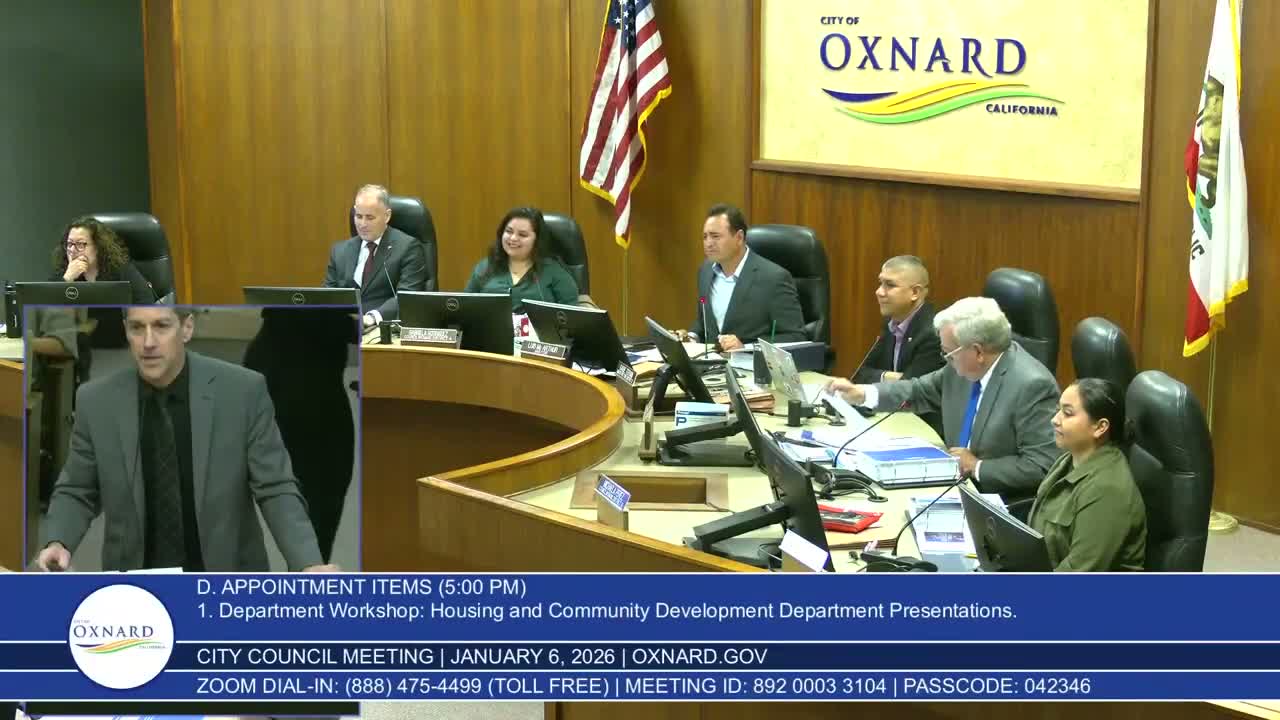
Summary
Director Jeff Bengali told the council the Community Development Department has reduced a post‑COVID backlog, is managing roughly 6,000 housing units on the horizon and plans a tentative March 27 go‑live for an enterprise permitting system, with months of adjustment expected.
Jeff Bengali, director of community development for the City of Oxnard, presented an overview of his department’s operations and projects, saying staff have reduced a post‑COVID backlog and are preparing to launch an enterprise permitting and licensing (EPL) system.
Bengali said the department is “filled by 70 full time employees” across three divisions — building and engineering, planning, and code compliance — and handles permitting, entitlement, CEQA work and inspections for the city. He told the council the department served more than 10,000 walk‑in customers in 2025, about 2,600 customers online and completed over 25,000 building inspections.
The presentation detailed the city’s housing pipeline: “we have approximately 6,000 units on the horizon and about 1,600 of those are under construction,” Bengali said. He framed that pipeline alongside long‑range efforts such as the Climate Action and Adaptation Plan (adopted 2022), the local coastal program update, and specific plans including the South Oxnard Connect transit‑oriented effort.
Bengali emphasized a recent decline in backlog after council funding in 2022 boosted staffing and consultant support. He said the department’s backlog fell sharply from earlier peaks to what he described as a “manageable number” and that the department processes workload amounts of roughly 200–300 units per month as a working benchmark.
On technology, Bengali described the EPL project (under development since 2024) that will enable digital plan reviews, an online customer portal with real‑time inspection and plan check status, and improved reporting. He showed the existing paper plan room and said the new system will modernize submissions. "This is tentative — don't publish it — but it's tentative March 27," Bengali said when discussing the planned go‑live, and he warned of “about 6 months of both customers and staff getting used to it and working out the kinks.”
Bengali also reviewed customer service innovations: a longstanding one‑hour Permit Fast Track program for business permits (about 28 years) and a residential fast track launched in January 2025 for ADU and small residential reviews; he reported the residential program runs about 85% full and the business fast track about 75% full. He noted the Permit Simple (Measure F) program has been implemented but has seen little applicant follow‑through despite eight training sessions.
The presentation included examples of major projects (Casa De Carmen and a logistics project), floodplain administration to meet FEMA standards and maintain the city's CRS rating, and the commercial cannabis program, which Bengali said had generated about $5.5 million in business tax revenue since 2022.
The department is recruiting to fill higher‑level planning and engineering roles, some of which have taken 18–24 months to fill; Bengali said the city is using recruiting firms and working with HR on salary ranges to be competitive. He closed by stressing retention and internal support as priorities while staff implement the new permitting system and manage an increasing workload.
The department will bring the EV charging franchise RFP, EPL implementation updates and coastal program milestones back to the council as those items progress.