
Lassen County supervisors hear sheriff, ranchers say wolf attacks are escalating and ask state, federal help
Get AI-powered insights, summaries, and transcripts
Sign Up Free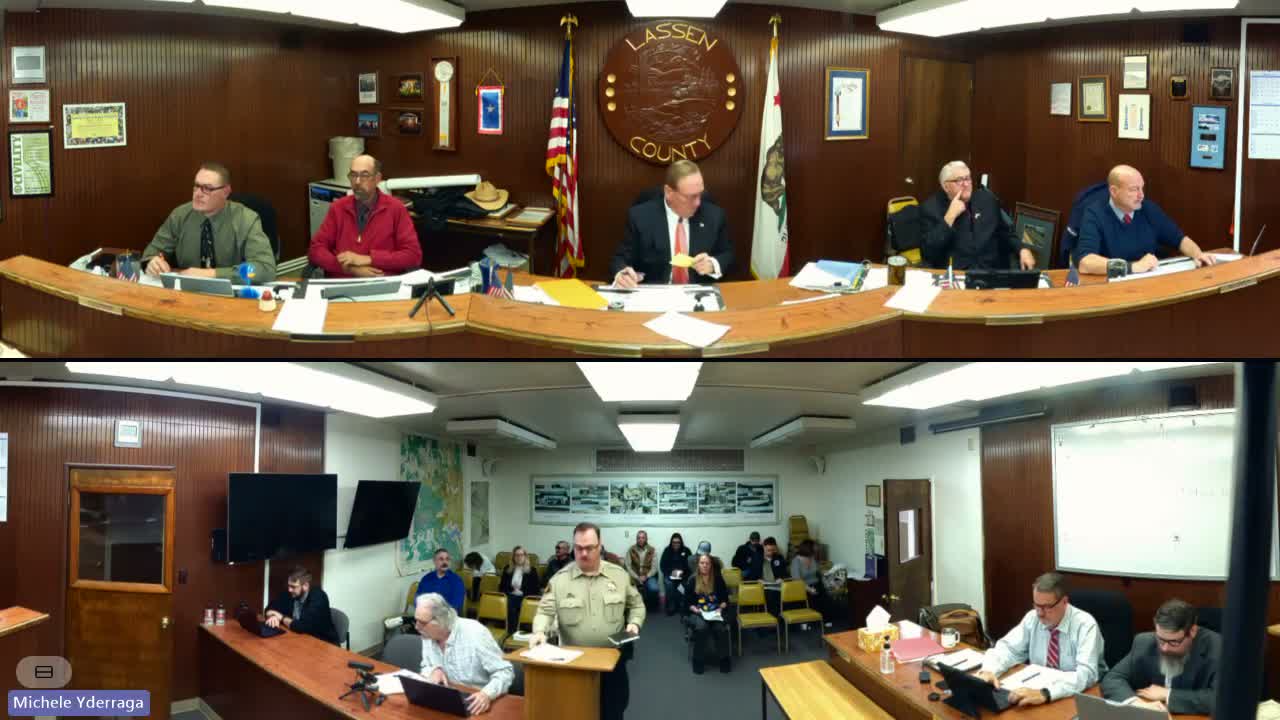
Summary
Sheriff and ranchers told the board that wolf depredations in Lassen County have escalated into a public-safety issue; stakeholders urged faster state and federal intervention, including more lethal control options and clearer compensation for losses.
John McGrath, the county law-enforcement presenter, told the Lassen County Board of Supervisors that recent wolf depredations have escalated in both frequency and proximity to residences, and that a single pack has been responsible for the bulk of confirmed attacks. "This is not getting any better," McGrath said, and he estimated roughly "about 40, probably 40 to 42" confirmed attacks last year. He said he has reached out to state and federal wildlife officials and that U.S. Fish and Wildlife Regional Director Paul Souza offered to meet local stakeholders in February.
Why it matters: Ranchers and residents testified the depredations have directly damaged livelihoods and raised safety concerns for families and children's play areas. Several speakers said state wildlife management has been slow to act, and they urged the county to press for direct, timely intervention and predictable compensation for livestock losses.
At the meeting, ranchers gave specific accounts. Wyatt Hanson described a New Year’s Day incident in which a calf and a horse were found badly wounded near family areas; he said partial compensation for prior losses is slow to arrive. "We had kills in November 24 that we haven't been paid for yet," Hanson said, calling for better information and "some lethal control" where packs prove dangerous. Taylor Hackettock and other public commenters argued that reduced deer and elk herds leave wolves with fewer natural prey, pushing wolves into livestock and residential areas.
Several residents criticized nonlethal deterrents and agency practices. Richard Egan argued repeated, low-effectiveness deterrents (he cited tinfoil as an example) only desensitize wolves and urged authorities to acknowledge management costs and pursue removal where warranted. Commenters also described frustrations with state contracting practices for collaring wolves, which some said create incentives that concentrate work on packs already collared.
The sheriff said his office is taking investigative steps — collecting incident reports, taking DNA samples where appropriate, documenting depredations and working with neighboring counties and federal partners. He said delisting of wolves is currently proceeding through the U.S. Senate and that the county will press its congressional contacts and regional directors for a faster, collaborative response.
What happens next: The sheriff said a USFWS regional director would likely visit Northern California in February to meet stakeholders; the board and multiple supervisors expressed support for continued pressure on state and federal agencies. No formal county policy change or new local ordinance was adopted at the meeting; the discussion concluded with a pledge from officials to keep the issue on the board’s agenda and to coordinate further with state and federal partners.
Representative quotes from the meeting: "They're not killing just to eat — they're killing just to kill," John McGrath said of the observed depredations. "I don't care if they have a refuge or a zoo... there also has to be some lethal control," Wyatt Hanson said. "Don't go down the rabbit hole of meetings that don't fix the problem," Richard Egan told the board.
The board did not take formal action beyond accepting the sheriff's report and hearing public testimony; next procedural steps are continued engagement with state and federal wildlife officials and follow-up stakeholder meetings when scheduled.