Get Full Government Meeting Transcripts, Videos, & Alerts Forever!
Get email alerts on the Open Meetings Sb707 topic
No spam. Unsubscribe anytime.
San Ramon council hears SB 707 overview; staff flags new rules on remote access, translation and disruptions
Summary
City attorneys briefed the council on Senate Bill 707 changes to Brown Act teleconferencing: guaranteed two‑way remote public access, ADA reasonable‑accommodation rules, expanded "just cause," new translation obligations, and a required disruption policy by July 1, 2026. Council asked about technology, monitoring and costs.
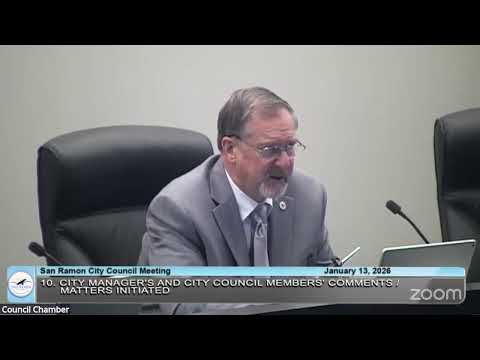
San Ramon — The City Council received a high‑level briefing on Senate Bill 707 on Jan. 13, with Assistant City Attorney Alicia outlining changes to Brown Act teleconferencing rules and how the city must respond.
Alicia told the council SB 707 modernizes the Brown Act to reflect post‑COVID meeting practices and defines "eligible legislative bodies" and "eligible subsidiary bodies," clarifying which advisory bodies are covered. "The core principles of the Brown Act are open meetings, public access," she said, and the bill "anticipates the new technological advances" by making remote participation an established option.
Key items Alicia highlighted included: a requirement to offer two‑way audio‑visual or telephonic remote access; recognition of teleconferencing as a reasonable accommodation under the ADA (with different rules if used as an accommodation versus for travel); expanded "just cause" reasons (for example childcare or contagious illness, limited to a defined number of uses annually for bodies that meet twice monthly); translation and remote‑access policy requirements; and explicit disruption procedures for remote participants. She told the council the city must adopt a disruption policy by July 1, 2026.
Council members pressed on practical issues. Council member Adler asked whether the bill creates operational concerns; Alicia said the law gives the presiding officer tools to remove disruptive remote participants and requires staff procedures for monitoring and restoring access. Council member Adler and others pressed about platforms and capacity; Alicia and city staff said the city manager's office is evaluating options and that some compliance can be achieved with existing equipment while broader translation services and web updates could require technology upgrades and additional spending.
Alicia emphasized documentation requirements: remote participants who rely on ADA accommodations must be identified in meeting minutes, the remote location and any adults present must be disclosed, and minutes must state the legal provision relied upon for remote participation. She also noted a one‑hour minimum effort to reestablish access if the public's connection is disrupted; if access cannot be restored within that period the legislative body must vote whether to continue.
Residents who filled speaker cards supported restoring two‑way remote public comment. "I very strongly support restoring public two‑way access and the ability to comment remotely," said resident Susie Ferris Inderkum during public comment.
What happens next: staff said it will continue to review platform options and to draft a disruption and remote‑access policy for council consideration before the July 1, 2026 deadline.
Reporting note: the council's presentation and all quotes above come from the Jan. 13 meeting briefing by the assistant city attorney and public comment recorded in the official meeting transcript.