Get AI Briefings, Transcripts & Alerts on Local & National Government Meetings — Forever.
Deerfield Beach pauses on switching from Broward Sheriff''s Office after heated public safety debate
Loading...
Summary
After a consultant's feasibility study and a forceful presentation from the Broward Sheriff, the Deerfield Beach City Commission declined to act Jan. 6 and asked for more data. The sheriff offered to fund a longer study and a two-year contract extension while commissioners seek detailed startup and staffing estimates before a Jan. 20 decision.
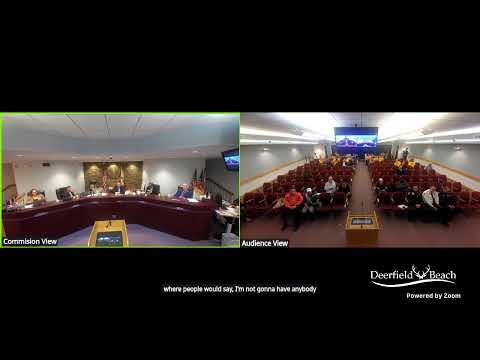
Mayor Drozky convened the Deerfield Beach City Commission on Jan. 6, 2026, to hear a 12-page feasibility summary on whether the city should end its 35-year contract with the Broward Sheriff's Office (BSO) and establish municipal police and fire departments. The feasibility presenter, Stockton Reeves of the Center for Public Safety Inc., said his executive summary showed potential long-term savings and described a path toward independent services, but emphasized the report was a feasibility analysis, not a transition plan.
The sheriff, appearing in person, urged a cautious, data-driven approach and sharply criticized the executive summary as incomplete. He called the memo "an advocacy memorandum" and said it omitted key operational, training and medical oversight elements; he repeatedly warned that gaps in planning could put lives at risk. The sheriff offered to fund a comprehensive transition or salary study and to extend the current contract for up to two years while the city conducts a full analysis.
Why it matters: The question before commissioners is both technical and fiscal. Supporters of staying with BSO told the commission that county resources, training depth and mutual-aid capacity protect residents during major incidents and that starting municipal agencies would require large upfront capital and persistent recruitment at a time when departments are short staffed across the region. Those urging change cited local control over budgets, personnel and policy and the consultant's projection that long-term savings could be significant if assumptions hold.
Key details and the record: Stockton Reeves said the consultant's model projected differences in long-term costs between continuing with BSO and delivering independent services; he also said the analysis used benchmark data from multiple Florida jurisdictions and industry sources and that the executive summary could be expanded with supporting spreadsheets on request. Reeves estimated a first-year operating differential in the millions and referenced roughly $21 million in capital outlay for both police and fire combined as a planning number in the presentation.
The sheriff said a thorough transition analysis typically runs far longer and costs substantially more than the 12-page memo presented. He identified what his office viewed as missing elements: EMS medical oversight, quality assurance, training infrastructure, accreditation pathways, force-modeling data, labor-relations planning and a dual-budget transition process. He offered to pay for a more comprehensive study and to extend the contract while the work is done.
Public input was extensive: more than three dozen residents and current or former first responders spoke during the item. Speakers in favor of remaining with BSO cited continuity, training and the difficulty of hiring and retaining paramedics and firefighters. Speakers who favored pursuing municipal services pointed to potential long-term budgetary savings and to the desire for local control. Several commenters asked the commission to take the sheriff up on his offer and fund a longer, independent transition study.
What the commission decided: Commissioners paused any immediate action. Several members said they lacked detailed, line-item certainty about startup capital, equipment and ongoing salary competitiveness and requested the city manager, consultant and legal staff to produce more granular information. The commission directed staff to clarify the sheriff's proposed two-year extension and study terms; no ordinance or contract change was approved at the meeting.
Next steps: The commission set Jan. 20 as the next opportunity to consider the item and asked staff to prepare a clear list of the additional data and cost assumptions commissioners want from the consultant and from BSO. The sheriff reaffirmed his offer to fund a comprehensive study and to negotiate an extension that would allow the city to evaluate transition costs without immediate service disruption.
Quotes that capture the moment: "This is nothing more than a 12-page memorandum that is an advocacy memorandum," the sheriff said of the executive summary, pressing for a fuller analysis before a decision. "We will be there for you as we have been for every other client," Stockton Reeves said, describing the Center for Public Safety's willingness to provide data and spreadsheets that underpin the executive summary.
Ending: With the sheriff's offer on the table, commissioners opted not to vote on a change; they directed staff to return with clarified contract terms, detailed startup and personnel cost breakdowns and any additional model assumptions before the Jan. 20 meeting.