
Democrats convene House Foreign Affairs hearing on Venezuela raid; experts warn of legal and strategic risks
Get AI-powered insights, summaries, and transcripts
Subscribe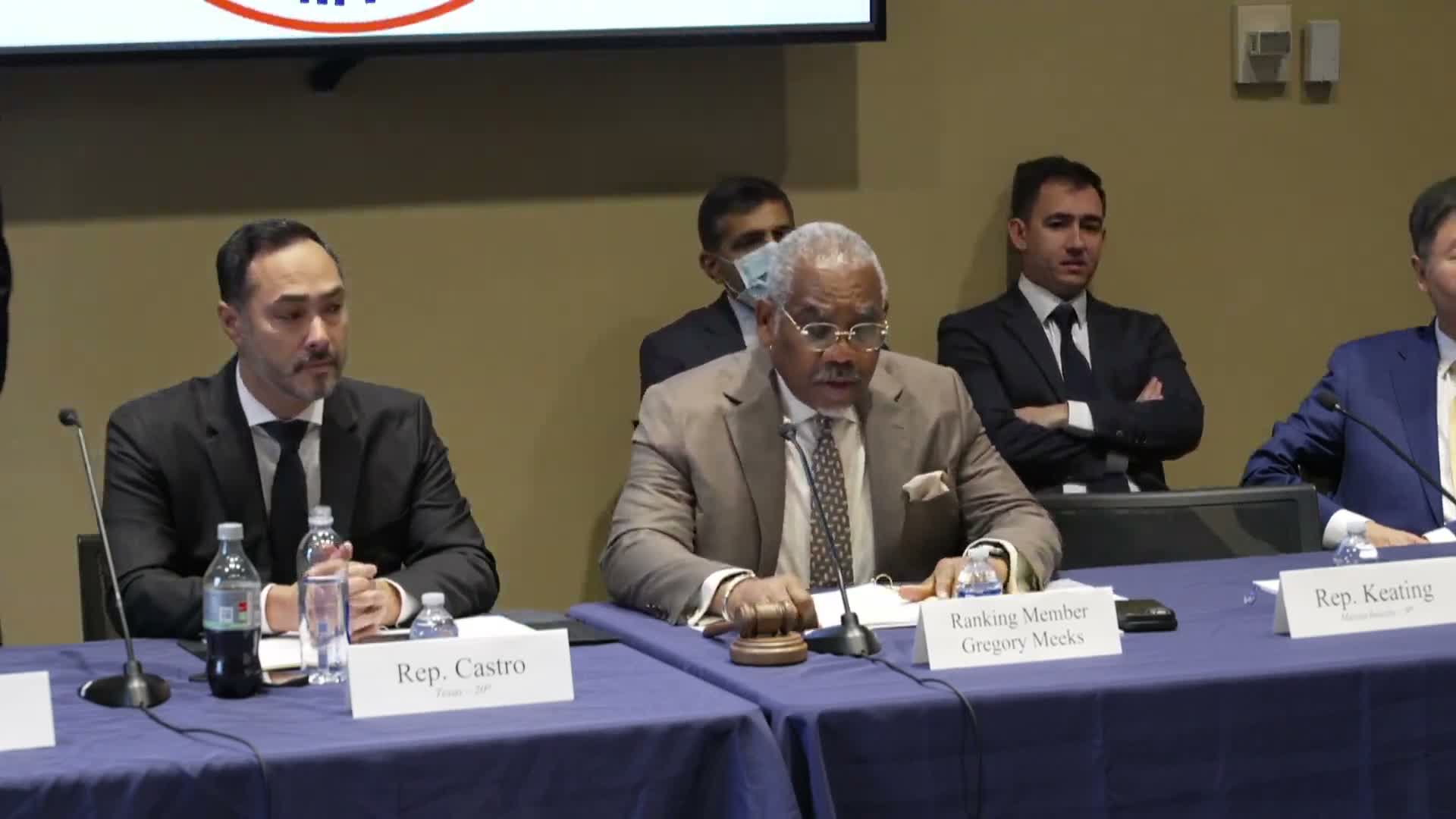
Summary
At a special hearing convened by House Foreign Affairs Democrats, three foreign‑policy experts testified that the U.S. military operation in Venezuela raised serious legal and strategic questions, including possible violations of the War Powers Resolution and the UN Charter, a lack of a credible post‑raid plan, and large reconstruction costs.
Democrats on the House Foreign Affairs Committee convened a special hearing to scrutinize a U.S. military operation in Venezuela and the administration’s plans for what comes next. Three outside experts — Thomas Shannon, Frank Mora and Bruce Filicane — told members that the raid and its aftermath raise deep legal, strategic and humanitarian concerns and that Congress has an urgent oversight role.
The experts told the committee they saw no credible plan to follow the operation. Thomas Shannon, a former under secretary of state for political affairs, said the raid “was not an act of regime change. It was an act of leadership change,” and warned that engaging with the remnants of the Maduro regime while excluding the democratic opposition risks greater political volatility in Venezuela.
Bruce Filicane, senior adviser for the U.S. program at the International Crisis Group, framed the operation as a legal problem for Congress. “The U.S. attack upon Venezuela was a usurpation of Congress’s war powers,” he testified, adding that the operation implicated Article 2(4) of the U.N. Charter and triggered the 60‑day clock under the 1973 War Powers Resolution.
Frank Mora, a former U.S. ambassador to the Organization of American States and deputy assistant secretary of defense, told lawmakers the United States cannot reliably shape Venezuelan governance from a distance. He said sanctions and limited economic engagement can influence behavior “at the margins,” but without a sustained diplomatic, development and enforcement presence the United States lacks the leverage to manage a political or economic transition.
Members pressed witnesses on a range of consequences: the risk of renewed repression, the prospect of armed fragmentation among militias and security forces if the regime collapses, and migration pressures for neighboring countries and the United States. When asked about the condition of Venezuela’s oil industry and the timeline for recovery, witnesses gave high‑level estimates rather than precise projections: a panel briefing cited to the committee said restoring Venezuela to 3 million barrels per day could take roughly 10 years and about $100 billion focused on the oil sector; other witnesses emphasized that institutional reconstruction would take longer.
Lawmakers also raised legal and ethical concerns about how the operation was framed. Filicane told the committee that classifying maritime strikes as governed by the law of armed conflict is misplaced where no armed conflict exists and said that, outside armed conflict, premeditated killings would ordinarily fall under criminal law. He urged Congress to review Department of Justice legal memoranda and to undertake “aggressive oversight” if the administration asserts novel justifications for the use of force.
Several members of the committee criticized the Republican majority for not holding public hearings with administration officials; witnesses and Democrats said the administration declined invitations to send senior State Department officials to the panel. Members pointed to possible policy motivations beyond counternarcotics — witnesses and several members noted repeated public references by the president to Venezuelan oil — and challenged the administration both on its stated legal rationale and on the absence of a transparent political strategy.
On the question of costs, witnesses declined to give precise overall price tags but offered comparisons and warning signs. One witness cited a briefing that placed oil‑sector recovery at roughly $100 billion over a decade; members also noted published estimates that a naval posture in the region had cost roughly $700 million with continuing daily operating costs cited in committee discussion.
Committee members ended by urging fuller congressional involvement. Witnesses recommended that Congress demand a clear strategic articulation from the administration, consider using statutory tools (including appropriations) to restrain unauthorized military action, and press for a political process that includes Venezuela’s democratic opposition. Chairman Meeks closed the session by saying the hearing underscored why timely congressional oversight matters and adjourned the special hearing.
The committee did not receive testimony from administration officials at the hearing; members and witnesses said additional public hearings with administration witnesses would be appropriate next steps.