Get Full Government Meeting Transcripts, Videos, & Alerts Forever!
Get email alerts on the Affordable Housing topic
No spam. Unsubscribe anytime.
New Canaan subcommittee reviews three town sites, weighs parking and public outreach to pursue 2032 moratorium
Summary
Consultants presented two schematic options each for Richmond Hill, Locust Avenue and the Lumberyard; the committee debated parking, phasing and outreach and set a Feb. 3 subcommittee meeting to select preferred options before public engagement.
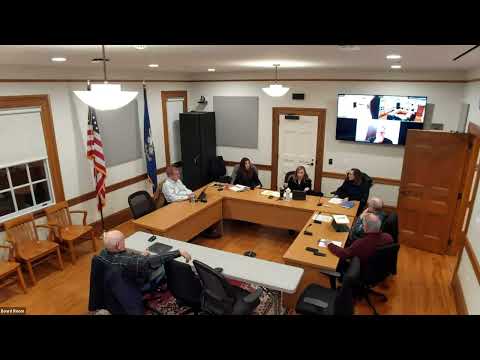
NEW CANAAN, Conn. — At a Jan. 20 special meeting, the Affordable Housing Committee’s project-development subcommittee heard schematic designs from consultants Amenta Emma for three town-owned sites — Richmond Hill, Locust Avenue and the Lumberyard — as members discussed whether and how the town could meet requirements for a rolling moratorium under state law by 2032.
Krista Nielsen, a subcommittee member who chaired the meeting, opened by outlining public outreach plans that would accompany a preferred option: “We could probably be to a preferred option by June,” she said, urging the group to “keep this process moving” so design, permitting and financing can proceed in time for certificates of occupancy required under the 8‑30g moratorium pathway.
Consultants Miles Brown and Jeremy of Amenta Emma presented two conceptual schemes per site that balanced unit yield, height (generally three to four stories) and parking. Richmond Hill, the smallest site, produced 18–20 units in the presented schemes but required decked parking that would be costly and still leave a shortfall of commuter spaces. “That first scheme gets us to 20 units,” Jeremy said, describing an L‑shaped, double-loaded corridor building and a townhouse‑style alternative. Committee members concluded Richmond Hill alone could not achieve the subcommittee’s 75‑units‑per‑four‑years benchmark for a moratorium without taller buildings or an off‑site parking solution.
Locust Avenue produced higher yields in the consultants’ options — roughly 76–89 units — by wrapping residential buildings around a flat‑plate structured garage and, in one scheme, adding limited street‑level commercial. The presenters said one variant would require acquiring adjacent properties for secondary access; members flagged traffic congestion and fire-department access as issues to resolve in later design phases.
The Lumberyard produced the largest yields — about 156–163 units in the consultants’ two schemes — and the most flexible phasing. Amenta Emma showed versions that build a multi‑level parking structure and then wrap residential buildings around it. The consultants noted the Lumberyard schemes produced residential parking ratios about 1.28–1.30 after accounting for existing commuter spaces; members debated whether a transit‑oriented site could reasonably use a lower parking ratio and still meet town expectations.
Discussion repeatedly returned to parking as the primary constraint on unit count and cost. Committee members noted that structured parking drives up per‑unit construction costs and that public acceptance of lower parking ratios for transit‑adjacent housing could be politically difficult. “I wouldn’t go below one per unit,” one member said, reflecting concerns about community reaction and demand from residents who continue to rely on cars.
Maria Weingarten, a member of the full Affordable Housing Committee, clarified the subcommittee’s remit: “We’re not mandated to build the housing. What we’re mandated to do is to zone for the creation of affordable units,” she said, emphasizing that the committee’s role is to recommend a path for the town to secure a moratorium under current state law.
On public engagement, the group debated whether to present two options per site on a survey and in a public meeting or to narrow to a preferred option before public outreach. Krista Nielsen proposed a soft launch at a Jan. 26 talk at the New Canaan Library and a longer survey window in February with a recorded meeting or explainer materials to give respondents context. The subcommittee agreed to reconvene in a subcommittee meeting at 7 p.m. Feb. 3 to narrow options; members asked Amenta Emma for order‑of‑magnitude cost estimates for any preferred alternative identified before the full committee update planned for Feb. 9.
The meeting closed with no formal votes taken and no public commenters on Zoom. The subcommittee will review the consultants’ slides, refine decision points and return on Feb. 3 to prepare for public outreach.