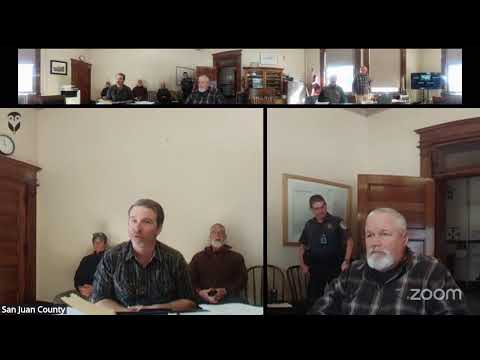
County staff brief board on state-mandated Wildfire Resiliency Code and 2024 building code update
Loading...
Summary
Planning staff recommended the county adopt the state Wildfire Resiliency Code and update to the 2024 building/energy code; staff said adoption must be complete by April 1 with enforcement by July 1, and warned the county may face heavy inspection and staffing demands, mapping complexities and conflicts with existing land-use standards.
Bevan, the county planner, told the board the state's Wildfire Resiliency Code (WRC) and updated energy/building codes will soon require local adoption and local implementation steps.
"It's gotta be adopted by April 1, and it's gotta be enforced by July 1," Bevan said, describing the state's timeline and the code's focus on new construction and major renovations.
Bevan explained the WRC primarily affects new construction and additions over about 500 square feet, and renovations that replace 25% or more of a structure's area. The code establishes classifications (for example, Class 1 and Class 2) tied to wildfire risk at parcel level and prescribes hardening measures such as ignition-resistant materials, tempered glazing, and defensible-space standards. He said much will turn on parcel-level mapping and site-specific conditions.
Commissioners and staff raised practical concerns: whether the county should adopt the standard countywide or only for properties in higher-risk interface zones; how to reconcile WRC clearing requirements with scenic or hiding-building rules; the administrative burden of permitting and tracking incremental repairs (the 25% trigger); and whether the county has staffing and enforcement capacity. Bevan said he is coordinating with La Plata County and regional fire and building officials to review drafts and explore shared approaches and suggested the county mirror the town's approach to keep rules consistent.
The board asked staff to prepare draft language for the WRC and the 2024 building/energy code for review at an upcoming work session, with the goal of presenting proposed ordinances to the board in coming weeks. Staff flagged that enforcement mechanisms, inspection schedules and public outreach will be central topics for the drafts.
A number of commissioners emphasized homeowner education and outreach first, and suggested mapping and GIS layers to make parcel-level risk transparent before enforcement begins.