Get Full Government Meeting Transcripts, Videos, & Alerts Forever!
Get email alerts on the Public Pensions topic
No spam. Unsubscribe anytime.
Greene County staff briefed on Loggers pension health; county pays employee share
Summary
At a Greene County staff meeting, auditor’s office staffer Annalise and employee delegate Paul summarized findings from the Missouri Local Government Employees Retirement System (Loggers), saying the system is largely funded and that Greene County covers employee contributions; staff were given contacts and materials for follow-up.
Annalise, a staffer in the Greene County auditor’s office, and Paul, an employee delegate to the Missouri Local Government Employees Retirement System (commonly called “Loggers”), briefed county staff on Loggers’ funding, benefits and retirement rules.
The presentation emphasized the plan’s investment returns and funded status. Paul told attendees: "For each dollar, Loggers receives during the year, 72¢ come from their investments," and he said Loggers "is about 92% funded," comments he used to reassure staff about long-term solvency.
Why it matters: County-sponsored pensions affect employee retention, retirement security and future budget obligations. Annalise said Greene County currently covers employee contributions for Loggers, a benefit she and Paul argued helps retain staff even if other employers pay higher wages.
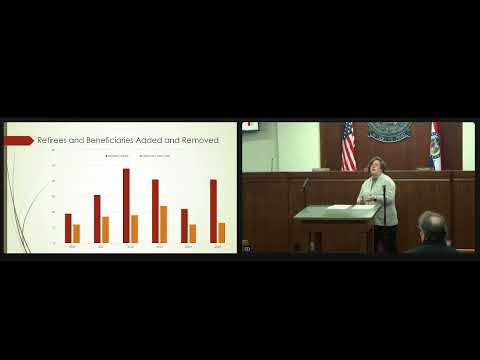
Details from the presentation and actuarial valuation: Annalise cited the Loggers annual actuarial valuation dated Feb. 28, 2025. She reported employer contribution rates for Greene County rose between 2020 and 2025 (general plan from 8.4% to 9.1%; police from 11.5% to 13.3) and said the county’s general plan is approximately 100% funded while the police portion is roughly 84%. She noted that, "by state statute, the contribution rate can only go up by 1% each year," a limit discussed as a constraint on how fast employer costs can increase.
On eligibility and benefits: Staff were told members vest after 60 months (five years). Normal retirement ages given were 60 for general members and 55 for police; early retirement carries a monthly reduction the presenters described as 0.5% per month (equating to a 30% reduction if taken five years early). Paul added that about one in six Loggers members nationally will be eligible to retire within two years, underscoring upcoming retirement-liability considerations for employers.
Application and post-retirement work rules: Presenters advised employees to file retirement applications 30–90 days before their first payment; Loggers pays benefits on the first business day of each month. The group discussed returning to work after retirement: presenters indicated a roughly 1,000-hour-per-year limit for returning to work with a Loggers employer and said suspending benefits to return to work does not necessarily restore an early-retirement reduction once applied.
Resources and follow-up: Annalise said she and Paul attended the annual Loggers conference and offered to share PowerPoint slides and recordings with staff. She recommended contacting Greene County payroll manager Kylie Wright or Loggers directly for detailed questions; the presenters listed Loggers’ web resources (mologgers.org/events) and email (info@mologgers.org).
There were no motions or votes during this presentation; the briefing closed after a question-and-answer period and staff were encouraged to contact payroll or Loggers representatives for more detailed, plan-specific information.