Get Full Government Meeting Transcripts, Videos, & Alerts Forever!
Get email alerts on the Emergency Management topic
No spam. Unsubscribe anytime.
Greene County staff rehearse crisis leadership model and an election‑day tornado scenario
Summary
County staff attended a Greene County huddle on crisis leadership that introduced Harvard's NPLI 'basement vs. penthouse' model and rehearsed an election‑day tornado scenario to discuss department coordination, unified communications and steps to preserve voter access during emergencies.
Greene County staff gathered for an internal training huddle on crisis leadership that walked participants through Harvard University's National Preparedness Leadership Initiative (NPLI) 'basement versus penthouse' framework and applied it to a hypothetical presidential election‑day tornado.
The presenter, identified in the session as the training facilitator, said the NPLI material was condensed from a full semester course and emphasized that "this isn't about bad leadership," describing the 'basement' as a stress-driven state where leaders default to fight, flight or freeze and lose strategic perspective. "One leader in the basement can pull an entire system down," the presenter said, urging staff to recognize those behaviors early and work intentionally to return to the calmer, strategic 'penthouse' state.
The session used an election‑day tornado scenario — with power outages, blocked roads and offline electronic voting machines — to illustrate how multiple county offices would need to coordinate. The presenter noted that emergency management would lead overall coordination, the sheriff's office would handle public safety and site security, Road and Bridge would clear access routes, and the county clerk's office would address election integrity and legal compliance. A participant told the group, "We're not [stressed] because we've got a plan," reflecting that some preparations already exist.
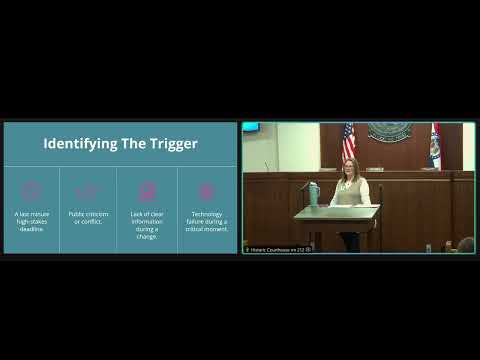
Staff participated in an interactive exercise identifying common triggers that push people into the 'basement,' including last‑minute high‑stakes deadlines, public criticism or conflict, lack of clear information during changes, and technology failures during critical moments. The presenter and attendees tallied responses during the exercise to focus discussion on which stressors were most salient locally.
Discussion emphasized practical steps employees can take during a crisis: pause before reacting; prioritize tasks that need immediate attention; offer to take concrete work off a leader's plate; and share only unified, coordinated public messages. Participants recommended leaders support stressed team members and requested unified communications so media and public inquiries do not encounter conflicting statements from different departments.
The training did not record any formal decisions or policy changes. The session concluded with encouragement to apply the 'basement/penthouse' concepts in future incidents and a brief informal closing.