
Greene County staff hold year-end huddle on 'servant leadership' and share examples of helping residents
Get AI-powered insights, summaries, and transcripts
Subscribe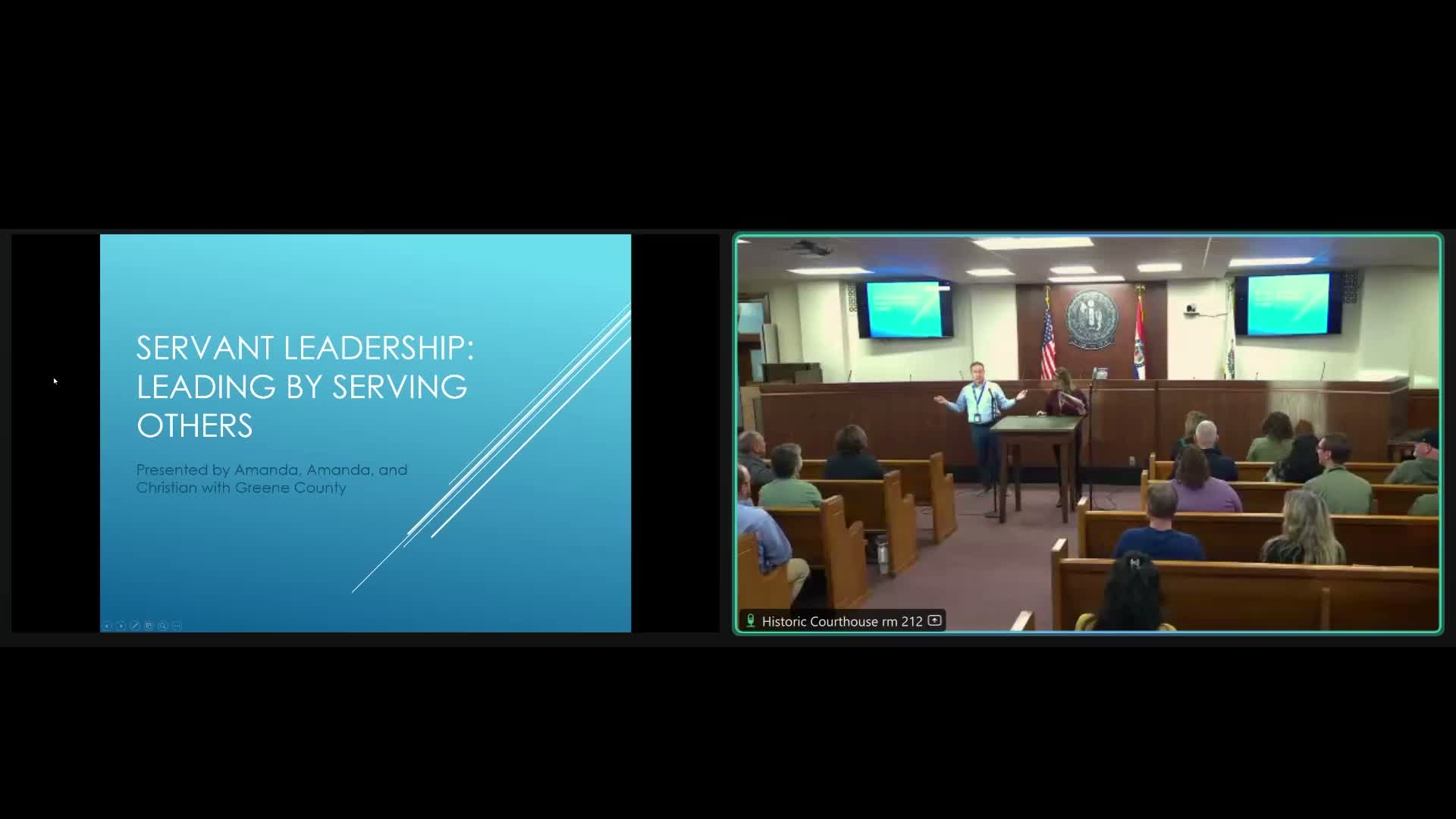
Summary
At a year-end Greene County staff huddle, presenters ran role plays and discussed small, daily actions—like answering a coworker’s phone or staying late to process payments—that staff said helped residents and improved workplace culture.
Christian Carroll, an assessor’s office employee, and colleagues led a year-end Greene County staff huddle focused on "servant leadership," running role plays and urging employees to adopt small, daily habits to support coworkers and residents.
In a role-play about a late arrival, presenters used contrasting responses to illustrate the concept. The facilitator simulated a harsh reprimand — "I don't care about your mom. Green County pays you, not your mom" — and then demonstrated an empathic alternative. That exchange ended with a practical accommodation discussed by staff: temporarily moving the employee’s start time to 8:15 or 8:30 for a few weeks to reduce stress, with a follow-up check-in planned in several days.
The session highlighted operational examples of staff serving residents. Carroll described an end-of-year surge at the assessor’s office when the payment line "from Room 39 past almost to the women's restroom" stretched late into the afternoon; staff volunteered to stay late so residents could obtain receipts the same day. Carroll praised about 20 employees who stayed beyond their shift, and mentioned clerk’s-office staff member Sharon Zittle who agreed to continue processing court orders so payments could be completed.
Presenters defined servant leadership as placing service to others first and using influence to "lift others, not to control others." They reviewed practical steps from a recent training, citing Robert Greenleaf as the originator of the concept, and encouraged workers to "coach instead of command," offer private praise, and notice small helpful acts that improve office culture.
The huddle included several short interactive exercises: employees introduced themselves in color-coded groups, acted out workplace scenarios (answering a coworker’s call, helping someone carrying many items) and discussed whether those acts constituted servant leadership or merely kindness. Human Resources staff member Amanda Corcoran and Clerk’s Office staff member Amanda Cutter participated in the demonstrations and fielded questions from attendees.
Presenters distributed handouts and said materials would be added to the slide deck for wider access. The meeting ended with a show of hands about leadership, closing remarks, and an early release for participants; presenters noted about 48 people attended.
No formal motions, votes, ordinances or public-policy decisions were made during the session; the meeting focused on training, culture, and operational examples.