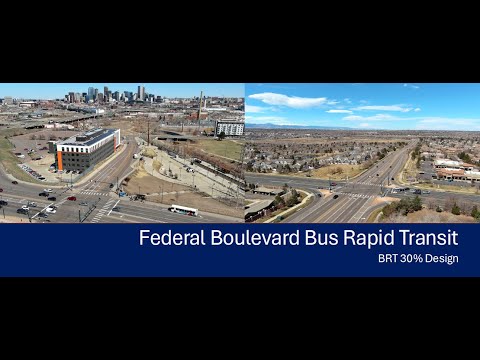
CDOT says Federal Boulevard BRT design is 30% complete; outlines station features and safety measures
Loading...
Summary
Colorado Department of Transportation engineering project manager Adam Spiker presented a high-level overview of the Federal Boulevard Bus Rapid Transit design, stating it was 30% complete as of December 2025 and describing station design, planned technologies, and steps to address community safety and business-access concerns.
Adam Spiker, engineering project manager with the Colorado Department of Transportation, presented a high-level overview of the Federal Boulevard Bus Rapid Transit project and said, "As of December 2025, design of the Bus Rapid Transit on Federal Boulevard is 30% complete." The video overview described planned dedicated bus lanes, transit signal priority, and station amenities meant to improve service reliability and user experience.
Spiker said the presentation shows a visualization near Federal Boulevard and 14th Avenue/Howard Place, just south of Colfax Avenue adjacent to the Decatur Federal W Line light rail station, and he encouraged viewers to review posted materials on the project website. He described the chosen station aesthetic as "Light and Shade," saying the design was favored "for its versatility, sleek appearance, and ability to provide reliable weather protection while blending into the surrounding streetscape."
The presentation listed station technologies and amenities that will be included at many locations: overhead digital displays, ticket vending machines and validators, an emergency call box, closed-caption TV and video displays at some stations. Spiker identified categories of community feedback collected during study and preliminary design: safety concerns about high vehicle speeds, intersection configurations, and pedestrian and bicycle crossings; service reliability where dedicated lanes are not present; station spacing, access and connectivity; and weather protection and personal safety at stations.
To address those concerns, Spiker said the design includes reduced vehicle design speeds, improved sidewalks and crosswalks, safer intersection designs, proposed bus bypass lanes at intersections with the highest transit delay, adjusted station locations, and station shelter design for weather protection and safety. He also noted that local business owners provided input focused on property and right-of-way impacts, customer access and street visibility, and construction duration, and that the project team used that input to refine design choices.
Spiker directed interested viewers to the project website (bit.lyfederalblvdbrt) for details and provided a contact address for questions and comments: federalBLVDBRT@gmail.com. The presentation did not include formal votes or a timetable for construction; it described the status of preliminary design and next steps to solicit further public feedback.