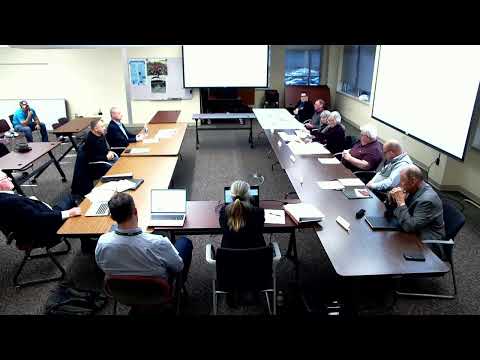
McHenry County Zoning Board denies conditional‑use permit for small animal‑processing facility at landlocked parcel
Loading...
Summary
After hours of testimony and two rounds of votes, the McHenry County Zoning Board of Appeals approved staff conditions but rejected a conditional‑use permit and two variances for a proposed on‑farm slaughter and processing facility (petition Z250068), denying the petition 6–1 on concerns about access, traffic data, and neighborhood compatibility.
The McHenry County Zoning Board of Appeals voted to deny petition Z250068, a request for a conditional‑use permit to operate food processing with animal slaughter and two variances (frontage from 330 feet to 0 and reduction of the 500‑foot residential separation to 217 feet), after extended public testimony and board deliberation.
The board accepted five staff‑recommended conditions by unanimous vote before considering the petition. Objectors’ counsel Thomas Birney urged denial in closing, arguing the petitioner had been "inconsistent" and lacked credibility: "There is no legitimacy to it whatsoever," Birney said, citing a PowerPoint his clients submitted documenting conflicting testimony about inspections, uses, and projected numbers. Birney told the board the site is effectively hidden from view, that the petitioner had not obtained easement owner approvals, and that neighbors faced traffic, health and safety, and property‑value risks.
Petitioner counsel Mister McKenna responded that the proposal is a small, agriculturally based on‑farm processing operation and that the easement access "runs with the land." McKenna said permits and oversight would control operations and argued compliance with county, state and federal rules: "At all times, during processing, there will be a USDA inspector on‑site," he said, and asked the board to recommend approval to the county court.
Board members divided over legal standards and practical impacts. Member Beverly, reading detailed findings, concluded the petitioner failed to meet multiple variance and conditional‑use criteria under the county Unified Development Ordinance (UDO), citing the absence of a traffic study, potential fire and emergency‑response concerns for a landlocked site, and incompatibility with planned estate zoning. "I do not find that the petitioner meets the standard for the variance," Beverly said in explaining her decision.
Member Eldridge dissented, emphasizing local demand for processing capacity and describing the proposal as a small facility that is unlikely to generate detectable external impacts: "Even with considerably more intense usage... this is a tiny facility," he said. Eldridge voted in favor of approval on the initial roll call; that approval motion failed 1–6 (Eldridge yes; six no). A subsequent motion to deny the petition passed 6–1.
Board staff clarified a legal point about parcel definition: Adam Wallen of the Department of Planning and Development summarized the state's attorney’s oral view that the UDO parcel definition (meets and bounds or original government public land survey description) should guide the board’s interpretation. Several board members noted the easement, deeds dating to 1896 and 1956, and disputed whether easement owner permission would be required to obtain building permits; the board said such property‑title disputes would have to be resolved in court.
The board recorded specific numeric elements in its discussion: the requested frontage variance would reduce the required 330 feet to 0; the requested residential‑separation variance would reduce a 500‑foot standard to approximately 217 feet; the petitioner’s acreage is discussed as 108 acres. Several members said the record lacked independent traffic, hydrology, or operational expert reports and that such data was required to satisfy UDO standards related to ingress/egress and public safety.
Votes at a glance - Staff conditions approved: 7–0 (mover: Miss Beverly; seconder: Mister Eldridge). - Motion to approve petition: failed 1–6 (Mister Eldridge voted yes). - Motion to deny petition: passed 6–1 (Mister Eldridge voted no on the denial).
What happens next The board recommended denial to the county; any unresolved property‑title questions about the easement or required written permissions were identified as matters for the county state's attorney or a court of law. The board closed the hearing and the record will be available through McHenry County permit channels.
Note on record inconsistencies: the hearing transcript occasionally uses differing jurisdiction names at opening; the record and staff materials consistently reference McHenry County.