
Commission committee previews changes to CWD rule; staff propose statewide carcass disposal and feeding ban in positive counties
Get AI-powered insights, summaries, and transcripts
Subscribe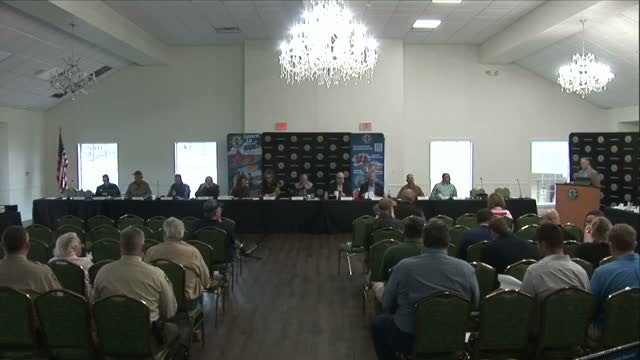
Summary
TWRA staff presented a preview of amendments to the chronic wasting disease (CWD) management rule, proposing a statewide carcass disposal requirement, a ban on feeding in CWD‑positive counties, and a narrower management zone; commissioners debated transport maps, zoning geometry, and implementation impacts ahead of a March rulemaking hearing.
TWRA staff previewed proposed changes to the agency’s chronic wasting disease (CWD) management rule and the wildlife committee voted to recommend the preview be forwarded to the full commission for rulemaking.
Chief Joe Benedict told commissioners that three recent detections — including Humphreys, Dixon and Williamson counties — prompted the agency to recommend an ‘‘evergreen’’ approach so newly positive counties would automatically be covered by a consistent set of responses. Benedict described three principal recommendations: add a statewide carcass disposal requirement, prohibit feeding in CWD‑positive counties (with narrow exceptions), and adjust the boundaries of the formal CWD management zone.
On carcass disposal Benedict said the agency’s draft language (adapted from other states) would require that ‘‘all parts of a deer carcass that are not kept or not provided to a taxidermist, processor, or tanner must be disposed of through normal waste stream as you would for household waste or left on the property where the deer was harvested.’’ The rationale, he said, is to simplify transport restrictions so hunters can still access processors without complex county‑by‑county rules.
Benedict also recommended banning feeding in counties where CWD has been detected, with exceptions such as food placed within 100 feet of a residence or as part of an approved wild hog management program. The agency proposed removing two counties (Wayne and Lewis) from the formal management zone while keeping the no‑feeding/no‑baiting and disposal provisions in effect for newly positive counties.
Commissioners raised logistical and equity concerns. Commissioner Moody and others asked whether county landfills and collection centers would accept carcass waste; Benedict answered that lined landfills can accept carcass material but noted local practices vary. Commissioner Blue urged a simpler approach of explicit zone lines covering Region 2 counties and suggested prohibition of baiting/feeding across that broader area to reduce spreading risk and enforcement complexity.
Dr. Dan Grove, the agency’s CWD coordinator, placed the measures in an epidemiological context: he said surveillance expanded over several years and that ‘‘roughly 5 percent is when you’ve already started to impact your populations’’ — a threshold at which environmental contamination and population impacts become more evident. Staff said they will prepare time‑series maps and alternative zoning visuals for the full commission.
Next steps: General counsel and staff will draft a red‑lined rule based on commission direction, file it for notice and hold a formal rulemaking hearing in March. The wildlife committee voted to recommend the preview for full‑commission consideration and a formal rulemaking timeline.
Why it matters: The proposed changes would change statewide handling and feeding practices and alter transport rules for harvested deer; those changes affect hunters, processors and local landfill operators and will be central to the March rulemaking process.