
TWRA and Tennessee Tech present multi‑year mallard telemetry findings; partners detail habitat investments
Get AI-powered insights, summaries, and transcripts
Subscribe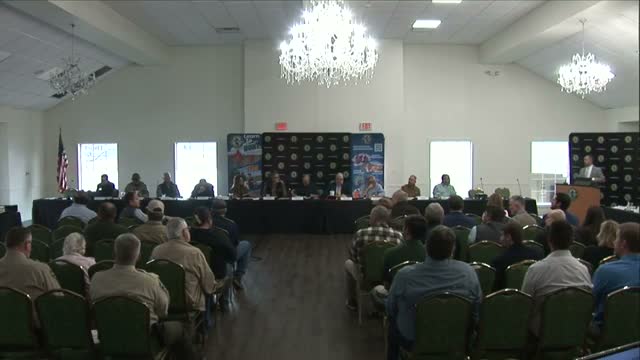
Summary
Researchers and conservation partners told the commission the agency’s multi‑year mallard telemetry project shows many ducks winter in Tennessee and that modest, distributed water and refuge areas (≈4–5% of the landscape) most reliably attract and retain mallards. Ducks Unlimited partners described matching funds that leveraged state dollars into habitat work in Canada and Tennessee.
Researchers and conservation partners presented a multi‑year study and related habitat work to the Tennessee Fish and Wildlife Commission during the committee day in Dyersburg.
Dr. Brad Cohen of Tennessee Tech summarized telemetry data collected on tagged mallards, saying the solar‑powered transmitters provide hourly GPS locations and ‘‘25% of our Ducks come back to the exact same spot.’’ Cohen said most tracked birds either remained in Tennessee for much of the winter or left the state by mid‑April, which implies managers need to retain water on managed fields at least through February and preferably March if the priority is waterfowl habitat.
Cohen said the study’s landscape analysis showed two principal factors that predict mallard settlement: the percentage of the landscape covered by water (roughly 45–50% is optimal at the local scale) and the percentage of sanctuary or refuge area. ‘‘You only need the landscape to be about 4 to 5% of safe area,’’ Cohen said, adding that reaching that refuge proportion would substantially increase the probability of imprinting and returning birds.
Cohen also addressed ‘‘flooded corn’’ and habitat heterogeneity, reporting the project’s analysis found that 2–4% of flooded corn in a landscape is sufficient to attract ducks and that exceeding about 5% was negatively correlated with duck abundance because overly homogeneous food sources reduce habitat variety ducks seek.
Howie Singer, manager of state partnerships for Ducks Unlimited Canada, described how Tennessee’s FY2025 contribution – ‘‘Tennessee was kind enough to send us $166,000 last year, FY '25’’ – was matched by DU and other partners and leveraged through federal programs to produce substantially more conservation spending in Canadian breeding landscapes where many Tennessee ducks originate.
Tyler Hand, Ducks Unlimited’s biologist for Tennessee, outlined state and regional wetland projects including completed levee and impoundment work at 3 Rivers WMA, planned impoundments at Shelton Ferry, and structure replacements at White Lake Refuge supported by grant awards. He described cost‑share and grant approaches – including North American Wetland Conservation Act and National Fish and Wildlife Foundation grants – and noted a TWA commitment of agency and DU cost‑share funding on larger projects.
Why it matters: The presentations linked on‑the‑ground habitat improvements, both overseas and in Tennessee, to outcomes in hunter opportunity and waterfowl distribution. Agency staff and partners argued smaller, distributed sanctuaries with reliable water create better outcomes than concentrating resources in a single large site.
What’s next: Commissioners asked staff to use the study’s spatial recommendations when planning future WMA acquisitions and infrastructure work. The commission will consider those planning priorities as part of its forthcoming habitat and budget discussions.