
CDOT recommends CMGC delivery for Federal Boulevard BRT to meet 2030 service goal
Get AI-powered insights, summaries, and transcripts
Subscribe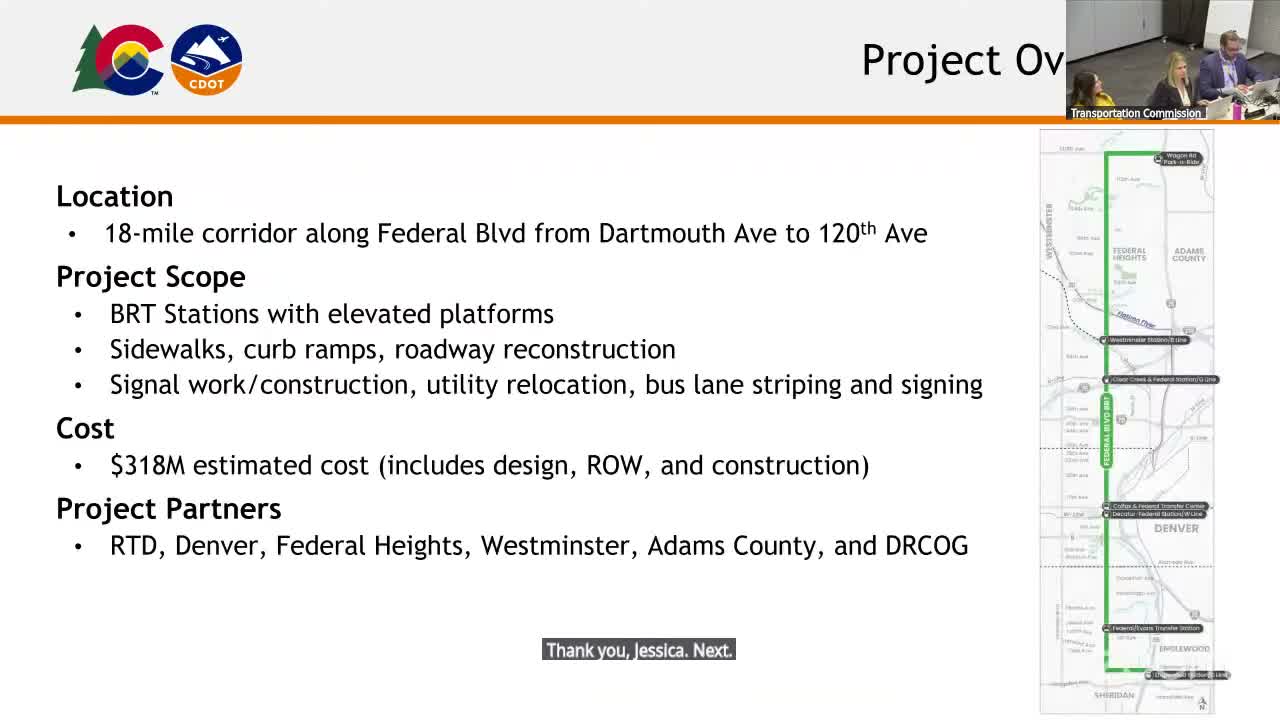
Summary
CDOT staff recommended using a Construction Manager/General Contractor (CMGC) delivery method for the 18‑mile Federal Boulevard Bus Rapid Transit corridor, saying it best mitigates schedule risk to achieve revenue service by 2030. The project has a medium‑high FTA rating and an estimated total cost of about $318 million.
CDOT staff recommended a construction manager/general contractor contract (CMGC) to deliver the Federal Boulevard Bus Rapid Transit project, saying the approach reduces schedule risk and enables phased construction needed to meet a January 2030 revenue‑service target.
Ryan Knowles, the agency’s bus rapid transit program manager, told the Transportation Commission the corridor spans roughly 18 miles from North Westminster (120th Avenue) to South Denver (Dartmouth Avenue), includes about 74 stations with near‑level boarding platforms, sidewalk and curb improvements, signal work and utility relocations, and has an estimated total cost of about $318,000,000 that covers design, right‑of‑way and construction.
"The CMGC method edged out design‑bid‑build primarily because of the delivery schedule criteria we weighted against," Knowles said. He explained CMGC lets staff and the construction manager collaborate early on packaging and phasing so parts of the corridor that are ready can start while other segments remain under design.
Why it matters: CDOT said Federal Boulevard is on the state’s high‑injury network and has a disproportionate share of serious crashes. The BRT project is intended to improve safety, increase transit reliability and reduce travel times so transit competes better with driving along the corridor.
Project status and funding: staff reported completion of a 30% design milestone and said the agency expects a NEPA document (anticipated categorical exclusion) this spring. CDOT is pursuing a $150,000,000 Federal Transit Administration Capital Investment Grant (Small Starts) and has $150,000,000 included in its 10‑year plan in fiscal years beginning 2027; staff also said they are seeking other programmatic funds and expect to advertise final design and procurement for a construction manager and an owner’s representative in the spring.
Next steps and approvals: CDOT said it will begin the construction‑manager procurement only if the Commission approves the delivery method. If approved, the agency plans to start construction in late 2027 and open BRT service to the public in 2030, subject to available funding and permitting.
The presentation noted partners include the Regional Transportation District, the city and county of Denver, Federal Heights, Westminster, Adams County and the Denver Regional Council of Governments. The Commission took no policy vote during this workshop; staff sought direction and said they would return with procurement steps.
Sources: Presentation to the Transportation Commission by Ryan Knowles; staff slides and Q&A.