Get AI Briefings, Transcripts & Alerts on Local & National Government Meetings — Forever.
Consultant outlines two-option downtown revitalization plan for Crescent City
Summary
A presenter detailed a two-option downtown revitalization plan for Crescent City on Nov. 13, summarizing outreach results, a market analysis that ties retail capture to visitor demand, and catalyst projects including a funded transit center, streetscape work, parking strategies and proposed anchor sites to spur private investment.
A presenter laid out a two-option strategy for revitalizing downtown Crescent City on Nov. 13, saying the session completes Phase 1 of the plan and moves the group into table discussions.
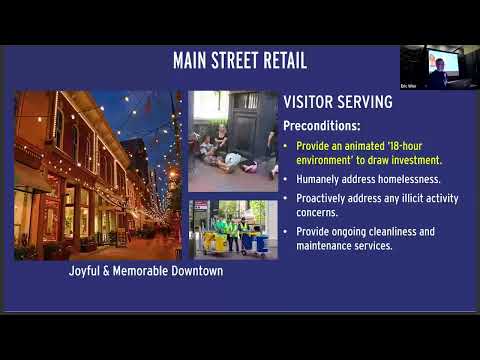
The presentation, described as a build-out vision, centered on three pillars—retail, parking and public spaces—and drew on community outreach (about 123 returned questionnaires) and a market analysis by Johnson Economics. "You need to move now like your hair's on fire," the presenter said, urging rapid coordinated action to convert visitor demand into downtown spending.
Why it matters: The presenter argued that downtown success depends on capturing visitors to nearby Redwoods parks and the waterfront. The market analysis cited in the presentation estimated about 2,000,000 annual visitors to the Redwoods as a potential customer base and suggested that, with the right interventions, downtown could add roughly 38,000 square feet of retail in 10 years and about 50,000 in 20 years. The consultant held up 100,000 square feet as a typical threshold for a vibrant main street.
Key proposals and priorities included a funded transit center and K Street/3rd Street streetscape improvements as early demonstration projects; a new, more prominent civic square (referred to during the talk as "Redwood Square" or Tsunami Plaza in different slides); targeted facade-improvement programs; and an approach to parking that combines leased or acquired surface lots with potential structured parking. The presenter estimated a parking structure near the transit center could yield about 320 spaces.
Design and land-use approach: The plan proposes mostly 3-story, context-sensitive buildings, a focus on active ground-floor retail frontage along 3rd Street, and a mixture of housing types including multifamily, condominiums and live-work units. The presenter emphasized avoiding displacement: "If you got a business and you wanna stay there for 20, 30, 40 years, nobody's taking your property," the presenter said, adding that any redevelopment would require further discussion with owners.
Catalyst sites and amenities: Two anchor sites were highlighted: a high-visibility, drive-by site near 3rd Street for a restaurant or regional tenant (~6,000 sq ft, estimated ~$5 million project) to magnetize visitors, and a vacant lot at G & 3rd as a mixed-use bookend better served by improvements on 3rd. The presenter also proposed a library program of about 10,000 square feet and discussed a FEMA tsunami evacuation tower co-located with civic parking in some options.
Streetscape elements: The consultant recommended undergrounding utilities where feasible, bulb-outs to shorten pedestrian crossings, additional street trees and pedestrian-scale lighting (separate from roadway lights), mid-block cable lighting, planters in parking lanes, improved sidewalks and provisions for event power and water taps. Trade-offs were noted: typical curb treatments would reduce on-street parking by about three spaces per block but increase safety and accessibility.
Housing and lodging: The two options differ in scale (the second option showed ~150% more development). The consultant described potential boutique hotel options (30–50 rooms) near Front Street and market-rate housing targeted at downsizers as part of the strategy to increase downtown spending power.
Implementation and funding: The presenter stressed the need to tie concept selection to implementation funding and regulatory updates (general plan and zoning) and suggested combining projects where feasible to assemble funding. Several projects were identified as time-sensitive; the transit center and certain K Street improvements were described as already funded or approved and intended as demonstration projects to show the future character of 3rd Street.
Next steps: After the presentation, attendees were given handouts and asked to break into tables for roughly 30 minutes to respond to goals and concept preferences and to choose a table representative to report back. The consultant said preferred and fallback (hybrid) approaches would be refined in future phases.
Attributions: All direct quotes and specific proposals are attributed to the Unidentified Speaker who presented the plan during the Nov. 13 workshop.
Ending: The presentation concluded with instructions for table discussions and an invitation to ask clarifying questions before the small-group work began.