
Crescent City Council unanimously grants variance for four‑unit development at 511 8th Street
Get AI-powered insights, summaries, and transcripts
Subscribe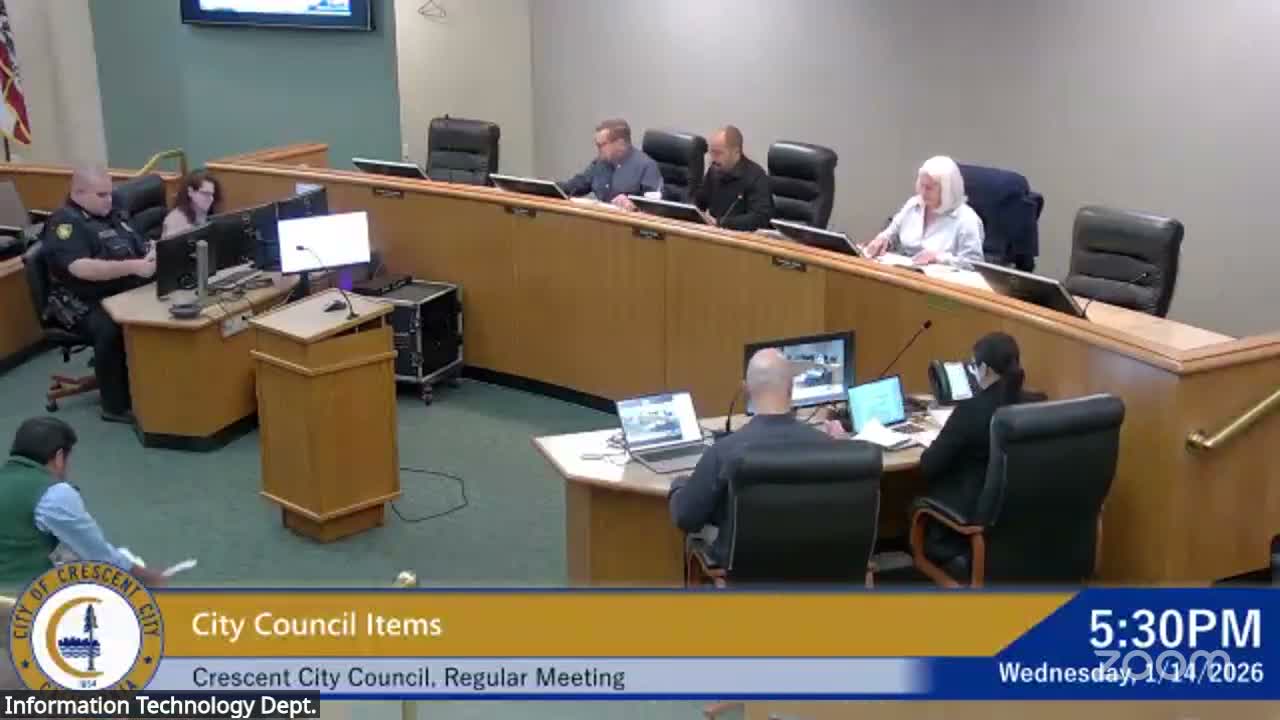
Summary
The Crescent City Council voted 3-0 to grant variance permit VAR 25-01 for a four‑unit residential project at 511 8th Street, adopting Resolution 2026-02. An appellant objected that some records were caught in a spam filter and requested a continuance; the council proceeded after staff confirmed the underlying record.
The Crescent City Council voted unanimously to approve variance permit VAR 25-01 for a four‑unit residential development at 511 8th Street and adopted Resolution 2026-02 after a public hearing and deliberation.
City Attorney Rice opened the hearing by explaining the council was sitting in a quasi‑judicial capacity and must base any variance approval on substantial evidence that meets the municipality's five required findings. Contract city planner Ethan Lawton told the council the proposal is for a residential‑only, four‑unit building in an MF‑15‑30 general‑plan designation. Lawton said the proposed building would be two stories with a 24‑foot height (below the 35‑foot limit) and a lot coverage of about 50%, and he recommended the council find the project consistent with the general plan and applicable zoning with the requested variances.
Lawton described three requested variances: an exterior side‑yard setback reduction from 10 feet to 8 feet 4 inches (side facing H Street); a rear‑yard setback reduction from 10 feet to 5 feet (northeastern side); and a parking waiver to allow rollover driveway parking for the fourth unit. He said the parcel is a legal nonconforming lot of roughly 5,227 square feet (the R‑3 zone minimum is 6,000 square feet), and staff had identified prior local approvals and neighboring properties with reduced setbacks as context for the request. On environmental review, staff recommended exemptions under CEQA for new construction, minor alterations, and infill development, noting the project is under six units and in an urban area.
Appellant Ardette Esselstrom told the council she had timely submitted responses and objections but that some of her emails were caught in a spam filter; she said she had not had a meaningful opportunity to review materials produced after her filings and asked the council to either adjudicate only on the existing administrative record or continue the hearing to allow fair review. “I timely submitted my responses and requests, and I did not receive notice that the city was not receiving them,” Esselstrom said, adding that her emails “were caught in a spam filter.”
City Attorney Rice responded that Esselstrom’s appeal had been received and that the items caught in the spam folder related to a Public Records Act request; Rice said public‑records retrieval would be addressed but that he saw no legal barrier to proceeding with the appeal because the planning commission had already held a hearing and that council members must apply the same record‑based standard. “Miss Esselstrom did submit her appeal, which we received,” Rice said.
Applicant representative Sam Schauerman of Elk Creek Builders, representing Battery Point Group, said he was available to answer questions. Council members asked technical questions about the submitted illustrations and landscaping. Lawton clarified the higher illustration was an alternative and that the proposed design is two stories, and he noted that city landscaping rules requiring common usable open space apply only to developments of five or more units; four‑unit projects face minimal landscape requirements.
After closing public comment (no speakers), the mayor closed the public hearing and the council considered motions. Council member Altman moved to grant the variance permit VAR 25-01 with conditions and to adopt Resolution 2026-02; Mayor Pro Tem Tinkler seconded. The council recorded a unanimous vote in favor (Altman: yes; Mayor Pro Tem Tinkler: yes; Mayor Wright: yes). The council then adjourned the special meeting and noted the next regular meeting was scheduled for Tuesday, Jan. 20 at 6 p.m. at the Fund Center.
The action grants the three requested variances as conditioned in staff materials and adopts the staff‑recommended CEQA exemption findings; council members explicitly relied on the planning commission record, the evidence presented at the hearing, and staff recommendations when making their determination.
What happens next: the resolution and the adopted conditions will form the permit approval; any further procedural challenges would proceed according to local administrative remedies and state law.