
Board debates SRO cost‑share with Tiffin; no vote taken
Get AI-powered insights, summaries, and transcripts
Subscribe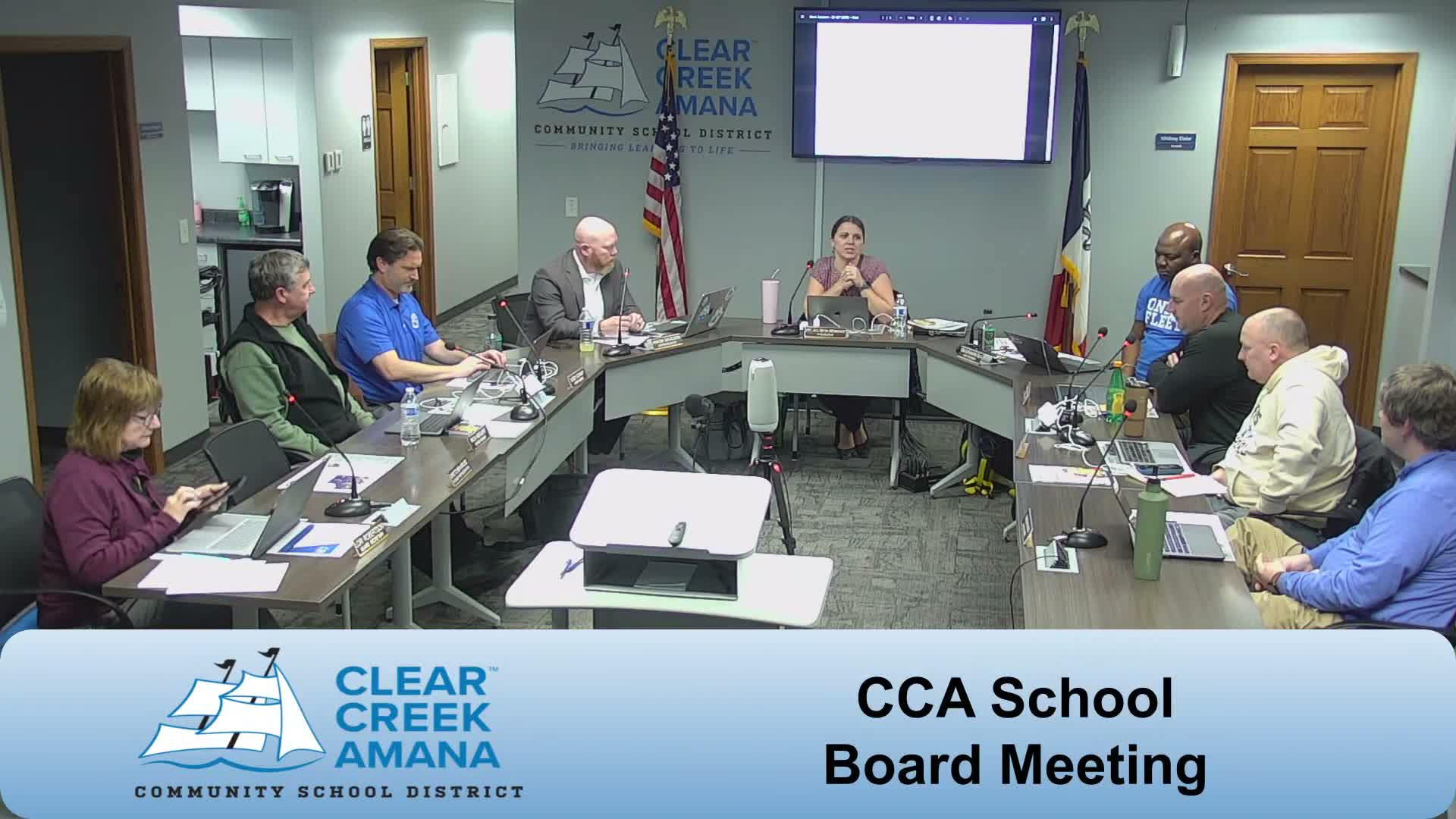
Summary
Board members discussed a proposed School Resource Officer (SRO) arrangement with the city of Tiffin and sheriff’s office, reviewed funding scenarios and allowed uses of at‑risk and operational‑sharing dollars, and asked for further details and a city‑board joint discussion; the board did not vote.
The Clear Creek Amana board spent an extended portion of Wednesday’s meeting discussing a proposed School Resource Officer (SRO) arrangement with the city of Tiffin and the county sheriff’s office but took no vote.
Speaker 1 said the current proposal in staff materials shows the district covering 85% of an SRO’s cost but that the board remained open to other splits. Speaker 9 summarized conversations with municipal partners and provided cost scenarios using a $141,000 "all‑in" annual estimate for a deputy: 85% of that cost would be about $119,850; 75% about $105,750; 65% about $91,650; and 55% about $77,550. He also noted an operational‑sharing credit (approximately four FTEs) that would bring roughly $32,000 into the district’s at‑risk budget if the district participates in shared positions.
"At 85%, that would cost us $119,850 a year," Speaker 9 said when walking the board through the math. He told board members a one‑year pilot with an initial lower percentage could be an option and recommended bringing the city council into a joint conversation before the next board meeting.
Board members pressed three related points: 1) whether at‑risk funds may be used for the SRO (Speaker 9 explained districts commonly use at‑risk and shared‑position dollars to support SROs and cited survey results showing families and staff reported increased feelings of safety); 2) language and expectations in the contract to limit the SRO’s school duties and prevent routine community patrol during school hours; and 3) how often a city or county deputy might be pulled from school duty to respond to other calls.
Several board members said they want clearer language about duties and boundaries, examples of contract language used by other districts, and more detail on the operational‑sharing credit mechanics. One member asked whether the SRO would be directly involved in school discipline; Speaker 9 said that, in his experience, the SRO would not handle regular disciplinary matters and would be involved only when a law‑enforcement response is warranted.
No formal decision was made; Speaker 9 said he would meet with the city official the next day and provide a written update and recommended a combined conversation with the city council in February so board members could ask questions before voting.