
Fall River Community Preservation Committee reviews eligibility applications for historic preservation grants
Get AI-powered insights, summaries, and transcripts
Subscribe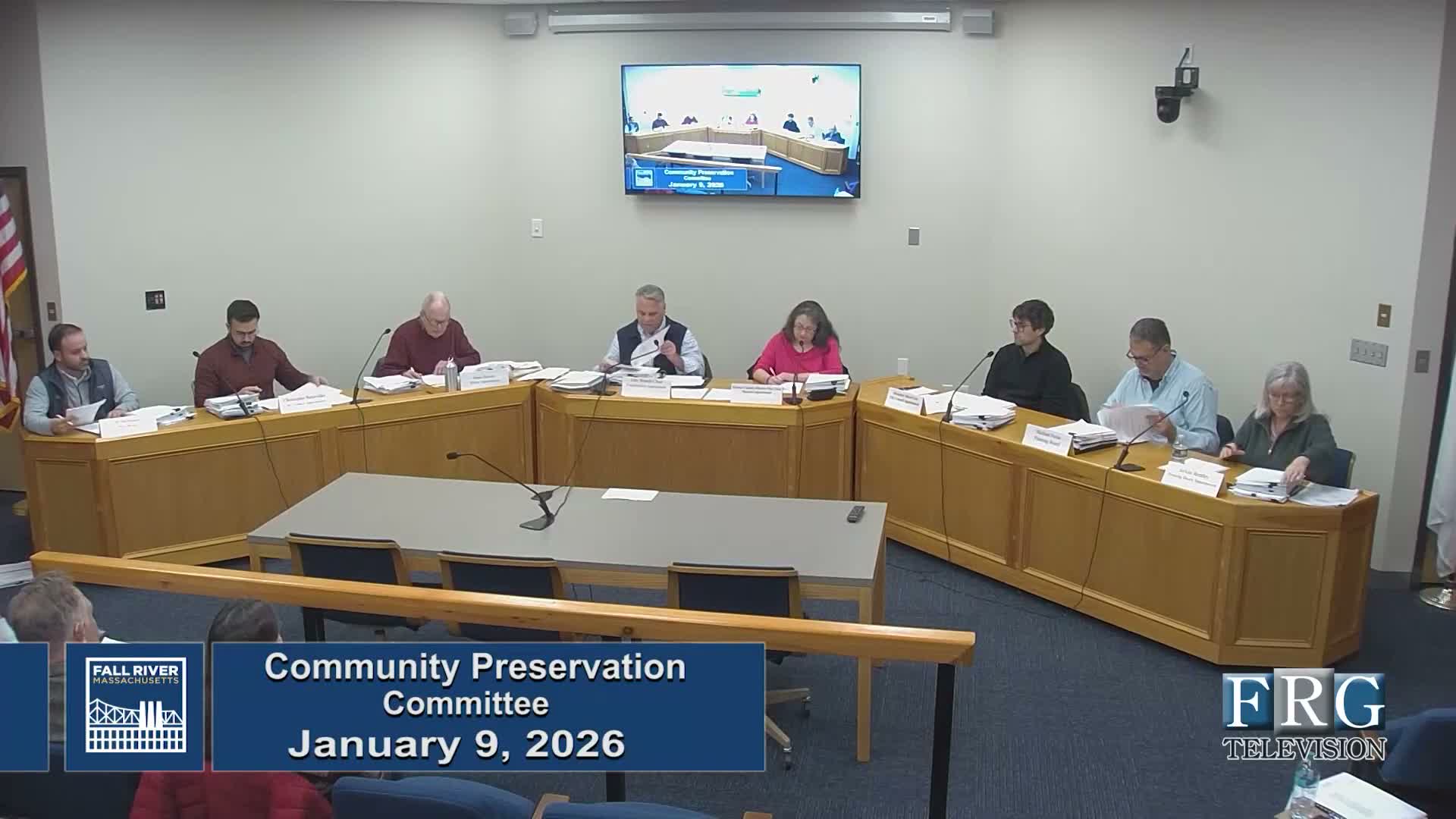
Summary
The Community Preservation Committee heard presentations from more than a dozen applicants Thursday, including Battleship Cove, the Forward Historical Society and several churches and nonprofits seeking funds for windows, masonry and preservation studies. Members focused questions on phasing, contractor availability, deed restrictions and project funding.
The Fall River Community Preservation Committee on Friday reviewed eligibility-stage applications for a slate of historic preservation and cultural projects, including window restorations, masonry and a waterfront cultural-asset study. Applicants described project scope, fundraising and contractor challenges; the committee set deliberations for Jan. 14 and a vote for Jan. 26.
Committee members asked detailed questions about whether work met Secretary of the Interior standards, whether deed restrictions would be acceptable and how applicants would phase projects if full funding was not available. Several presenters said they would accept a preservation deed restriction if awarded funds.
Battleship Cove sought funding to restore first- and second-floor windows and to protect archival material. Chris Nardi, identified in the presentation as chief operating officer of Battleship Cove, said the north-side second-floor space contains archival collections and that staff discussed adding UV film to glazed openings “for exactly that reason,” and that the organization prefers restoration when original sashes are available. The application amount was read aloud by staff as $369,763; Nardi said the group would phase work and use an annual bequest to support the project if the committee granted partial funds.
Grace Gerling, executive director of Greater Fall River Recreation, presented a proposal to replace 67 courthouse-area windows at 45 Rock Street. Gerling said prior exterior work (roof and repointing) and interior upgrades have been completed and told the committee “we have $61,000 that we can put towards the project.” Committee members noted higher-than-typical per-window bids and asked whether restoration had been considered; Gerling said the oldest (c.1908) windows are significantly deteriorated and some vendors declined because of the specialty work required.
A Waterfront Cultural District study requested $28,000 of a $48,000 project to catalogue and interpret historic assets along the waterfront. A committee member said an inventory could support waterfront development and promotional work.
At Lamport Mills (Shane Landing), Andrew Barclay of RGB Architects represented owner Patricia Todd for a $350,000 request to replace or restore 75 first-floor windows. Barclay said the owner intends phased work, starting with the first floor to make the building watertight and then seeking subsequent funding rounds for upper floors. He and Todd said multiple contractors were contacted; several declined because the windows are specialized and quotes that did arrive were high.
Other applicants included the Forward Historical Society (project total about $3.507 million with $2.924 million raised in private funds), the Eagle Event Center (applicant clarified the grant request should read $133,405 after accounting for other funds), Saint Anne’s Church (masonry and mortar phases, contractors named), the former Deaconess Home (porch restoration, estimates presented around $90,000–$100,000), Saint John the Baptist (application accepted for consideration because the site is open to the public), Cathedral of Saint Mary (bell tower phase within a larger multi‑year program; applicant explained high scaffolding costs), and First Congregational Church (phased bell-tower and wall stabilization work). Representatives emphasized community programming and public-access benefits in many cases.
Committee members repeatedly pressed applicants on contractor availability and price variation, encouraged applicants to phase work that would produce visible public impact first, and affirmed that deed restrictions are standard for CPA-funded historic preservation work. No final votes on projects were taken at the meeting. The committee adjourned after a roll call and will reconvene for deliberations on Jan. 14, with formal votes scheduled for Jan. 26.