USU researcher: rich seed bank and early gains from high-diversity seeding on Utah Lake’s North Shore
Loading...
Summary
Emily Santos of Utah State University presented interim results from a four-year restoration demonstration on Utah Lake’s North Shore, reporting a species-rich seed bank with no phragmites detected and first-year gains from high-diversity seed mixes that increased native cover and reduced bare ground. The project compares seed-bank resilience, passive recolonization, and active seeding across randomized plots and will continue monitoring for two more years.
Emily Santos, a PhD student at Utah State University, presented preliminary findings from a four-year wetland restoration demonstration focused on the North Shore of Utah Lake. The project compares seed-bank viability, passive recolonization, and active seeding across randomized, replicated plots to identify restoration strategies that can withstand extreme and variable hydrology.
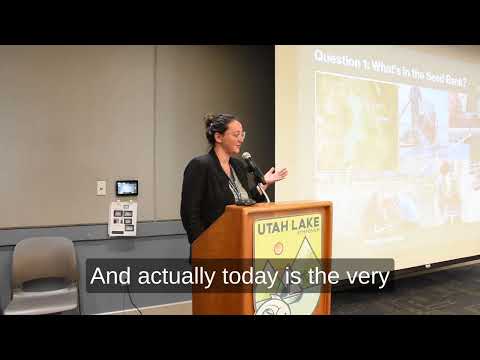
Santos said the team conducted a greenhouse germination experiment using soil and submerged sediment collected along the shoreline to characterize viable seeds in the seed bank. "Today is the very last day of the experiment," she said, explaining the work began in April and samples have been grown for six months. The team also established resilience treatments that simulate hydrologic swings — two years flooded, two years dry, and alternating flood/dry — to test how seed-bank communities respond over time.
On preliminary seed-bank results, Santos said the samples were "super rich" with many native species and "there are some invasive plants, but there's no phragmites, which is incredible." She cautioned these are early results from year one of the project and the team will repeat resilience tests in two years to assess persistence.
In the field, Santos described passive-monitoring plots across the North Shore using a quadrat method to record species composition and compare natural recolonization with seed-bank potential. She reported overlap between seed-bank species and field vegetation but noted that invasive species including phragmites and tamarisk are present in the field even though phragmites were not found in seed-bank samples.
The project also ran an active seeding experiment this summer in collaboration with Forestry Fire and State Lands. At three sites, teams hand-seeded randomized, replicated blocks; each plot is one-tenth of an acre and seeding was applied at the same rate a broadcast seeder would use for large-scale efforts. Santos said two mixes were tested: a low-diversity "workhorse" mix and a high-diversity mix that combines workhorse species with a broader suite of native wetland and pollinator plants.
Preliminary vegetation surveys from the first-year monitoring showed positive differences in seeded plots. "High diversity seed mixes increased native cover, and decreased the bare ground" compared with non-seeded control plots, Santos said, adding that reducing bare ground can lower opportunities for prolific invasive establishment. She emphasized these results are first-year observations and will be tracked across the remaining monitoring period.
The team is also tracking costs and logistics to evaluate the trade-offs of seeding at scale; Santos identified major expenses such as Marshmasters used for tractor work and the broadcast seeder, and noted that lab work for viability testing and seed-mix calculations adds to overall effort. The project is in year two of four and plans deliverables that include seeding guidance for extreme hydrology, a cost–benefit analysis, practitioner training materials, and a seed-bank resilience report comparing baseline samples to the experimental treatments.
Santos closed by acknowledging collaborators, graduate and undergraduate student contributors, "our seed collectors at Great Basin and Cerner Seed," and introduced Keith, a seed collector who would present next. The team will continue field monitoring and repeat greenhouse resilience trials to assess whether passive recolonization suffices or active seeding yields more resilient native communities.