Keynote warns against large-scale engineering: 'conserve first' for Utah Lake recovery, cites June Sucker progress and new coalition
Loading...
Summary
Dr. Ben Abbott told attendees that Utah Lake should be managed with conservation first, warned that past interventions (including 1960s hexadecanol trials) caused fish kills, and highlighted recent organizing (Great Salt Lake Rising) and June Sucker recovery progress.
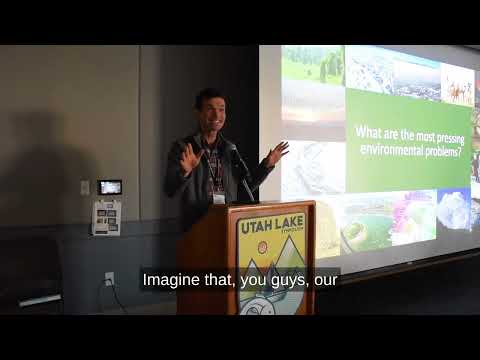
Dr. Ben Abbott, a global ecologist at Brigham Young University, told attendees at an event focused on Utah Lake that conservation and preventative measures should come before heavy engineering when restoring the lake.
Abbott said Utah Lake provides extensive ecosystem services and cautioned that large interventions carry risk. He recounted a historical attempt in the 1960s to spread hexadecanol on the lake to reduce evaporation, which he said “ended up causing massive fish kills” and harmed the June Sucker population. Abbott used that example to argue for humility and caution in future proposals.
On the lake’s role in regional hydrology, Abbott cited recent Utah State data and said roughly half of the rain and snow that fall in Wasatch Front valleys originate from Great Salt Lake and Utah Lake’s recycling of moisture. He argued that the solution is to conserve water in the watershed so more water flows through Utah Lake and into Great Salt Lake, producing co-benefits for both systems.
Abbott provided a scale estimate for Utah Lake’s current storage, saying the lake holds about 1,000,000 acre-feet of water and that achieving recovery for downstream systems would require additional conserved water roughly equivalent to the lake’s current volume.
He also highlighted biological recovery: Abbott said the June Sucker Recovery Program has seen demonstrable progress, noting decreased chlorophyll-a concentrations since the 1990s attributed to better agricultural and municipal waste management and that the June Sucker population has been improving and was downlisted.
On political mobilization, Abbott described the coalition Great Salt Lake Rising, formed with Josh Romney, and said that the coalition, working with the legislature and governor's office, secured a joint resolution committing to lake-rescue goals linked to a 2027 target window. He cautioned that the default outcome remains decline unless values and conservation actions shift.
Abbott closed by urging community engagement and sustained, evidence-based policy rather than quick reengineering of the lake.