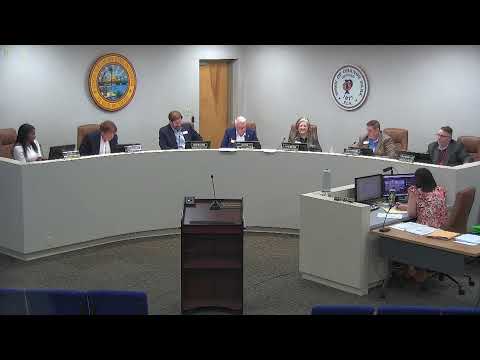
Flock Safety presents license-plate readers; residents raise privacy and surveillance concerns
Loading...
Summary
A Flock Safety representative told the Orange Park Council LPR cameras capture rear-vehicle photos, that partner agencies own data, and that images are deleted after 30 days; residents and privacy advocates pressed for independent audits, limits on data sharing, and local controls under Florida law.
A representative from Flock Safety, addressed later in the meeting as "Mister McCormick," outlined the company's license-plate reader (LPR) camera system and told the Orange Park Town Council the cameras produce point-in-time photos of the back of vehicles that municipalities, not the company, own and control. He said agencies upload on a case-by-case "hot list" for investigations and that images are retained for 30 days before being "hard deleted." He described audit logs, multi-factor authentication for user access and a baseline accuracy rate of about 94 percent for plate reads.
The presentation emphasized local control over sharing: communities decide whether to share data with neighboring towns, counties, states or a national lookup. McCormick said Flock does not sell photos, does not provide facial-recognition products as part of the LPR offering, and that private customers (HOAs, businesses) cannot access law-enforcement hot lists. He also described an opt-in partnership with Ring that would allow private doorbell footage to be shared with law enforcement only if a resident consents.
Town Attorney: Florida law limits uses
The town attorney briefed the council on Florida Statute 316.0777, which specifically governs automatic license-plate-recognition systems. He told the council that Florida law limits agency use to active criminal intelligence or investigative information and that certain images and personally identifying information created through such systems are confidential and exempt from public-record disclosure except in narrow circumstances.
Residents press for limits, audits and local policies
Public comment filled much of the evening. Madison Hill, a resident and former Clay County staffer, disputed company reassurances, pointing to external audits and reports she said revealed data-sharing violations and a lack of independent third-party audits. "Block's default contract shares data with every single agency nationwide," she said, urging the council to "please restrict it." Other speakers raised similar concerns: the possibility of wrongful stops from false matches, cybersecurity and hack risks, plans to add video capabilities in the future, and the potential disproportionate impact on immigrant and other vulnerable communities.
Several residents asked the council to either reject the contract or adopt a strict local LPR policy spelling out retention, sharing permissions, auditing and independent oversight. Some speakers also asked whether the town could require local storage rather than vendor-hosted cloud storage.
What comes next
Councilmembers asked staff to gather state-specific information about public-record rules and security measures and to return with options. The town attorney’s reference to Florida Statute 316.0777 frames the legal limits on agency use, but residents urged the council to consider additional local policies or ordinance language to restrict data sharing, require independent audits and clarify retention and deletion practices.
Ending: The council did not vote on procurement or a contract at this meeting; councilmembers and staff said they would provide follow-up information and discuss policy options at a later date.