
Hospitals’ transformation plans due; officials say federal RHT funds can help but won’t replace planning
Get AI-powered insights, summaries, and transcripts
Subscribe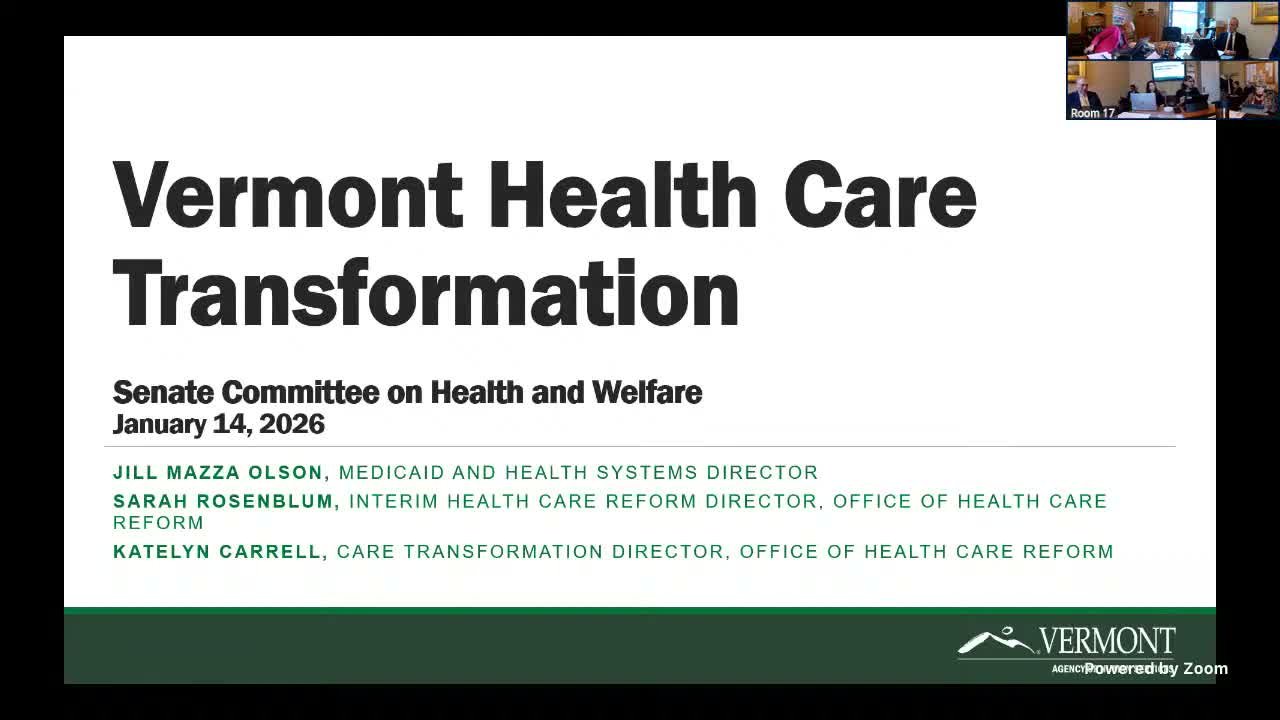
Summary
Care transformation staff told the Senate Health & Welfare committee that hospital draft transformation plans are due this week and final plans in March, and that Vermont’s Rural Health Transformation grant can accelerate—but not replace—regional planning and capital priorities such as EHR upgrades and transport systems.
Agency of Human Services staff told the Senate Health & Welfare committee on Jan. 14 that hospital draft transformation plans were due the week of the meeting and that final plans are scheduled for March. Katie Carroll, AHS care transformation director, said AHS will summarize drafts into categories (optimization, innovation, regional progress) and return with consolidated findings for the committee.
Carroll described regional convenings where hospitals and local partners are discussing shared services, specialty networks and ways to coordinate transfers. “We’re moving into regional transformation planning as well as implementation,” she said, noting initiatives such as a unified health record, expanded telehealth, coordinated transfer and transport, and shared specialty networks.
Committee members pressed AHS about how the federal Rural Health Transformation (RHT) grant will be used. The chair and staff said the grant—described in the briefing as a $195,000,000-per-year award—can accelerate projects that need capital (for example, electronic health records and transport infrastructure) but “the grant is a tool in our toolbox,” Carroll said. Staff emphasized some tools do not require new funds, while others will need investment.
Members raised community-impact examples. One senator said North Country lost a neurologist and fears patients will have to travel regularly to larger centers; another asked whether hospitals’ shift to outpatient and ambulatory services is drawing revenue away from community-based providers. Members also voiced public concern about potential Medicare telemedicine coverage changes; staff and the chair said there had been a waiver extension and that they would clarify the policy for the committee.
A committee member said hospitals reported achieving about $230 million in cost reductions last year; staff directed detailed financial questions to the Green Mountain Care Board for verification. Carroll and Rosenblum said hospitals are sometimes reluctant to put tentative ideas in writing while trust is being built; AHS emphasized its consultative role rather than a regulatory one.
Next steps: AHS will summarize draft plans and return with implementation details, including how RHT funds might be allocated to accelerate regional priorities.