
Vermont Supreme Court27s Taft Street decision narrows municipal authority over farming, counsel says
Get AI-powered insights, summaries, and transcripts
Subscribe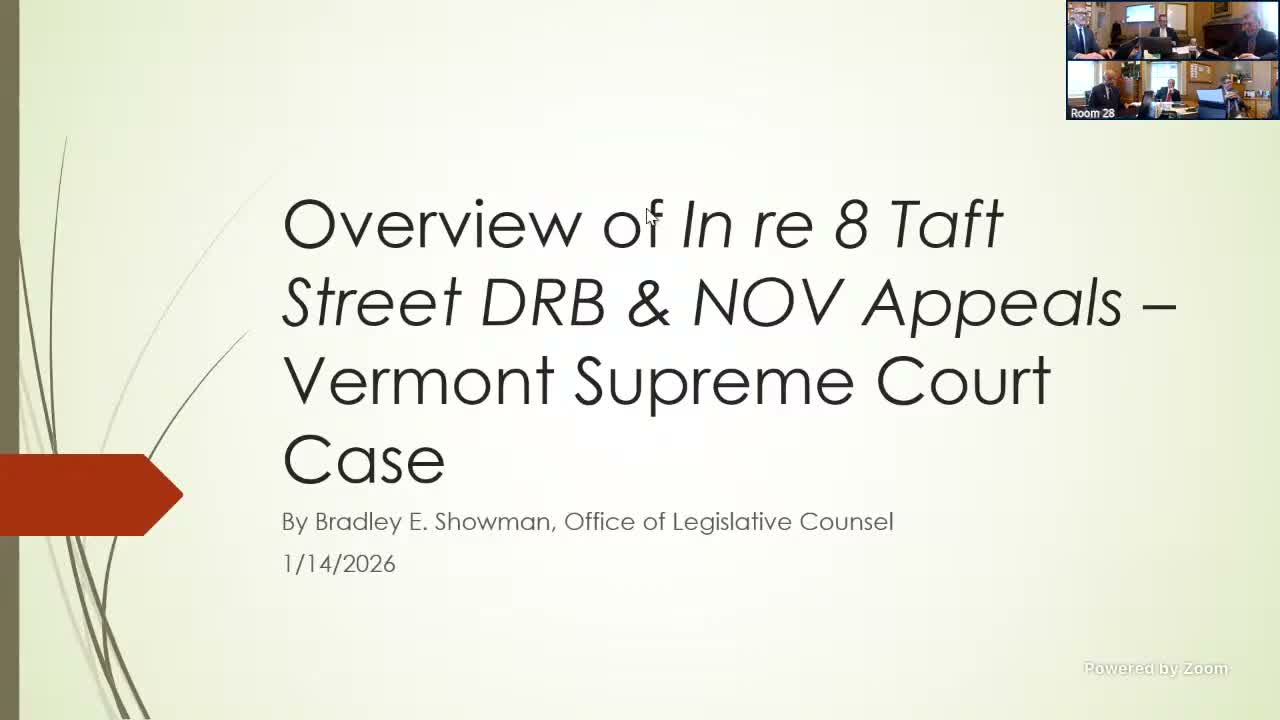
Summary
Legislative counsel Bradley Schoeman told a committee the May 30 Taft Street decision interprets the statute narrowly: municipalities may not regulate what the Required Agricultural Practices (RAPs) require, but they retain broad authority over noise, traffic, setbacks and other local land-use rules; the Agency of Agriculture is expected to propose a legislative fix.
Bradley Schoeman, legislative counsel, told a legislative committee that the Vermont Supreme Court27s May 30 Taft Street decision limits municipal authority by interpreting the statute narrowly rather than broadly.
"A bylaw shall not regulate required agricultural practices," Schoeman said while reading the statute, and explained the court held that provision bars municipalities only from regulating what the Required Agricultural Practices (RAPs) themselves require, not all municipal regulation of farming activity. "The relevant statute does not prohibit all municipal regulation of farming if that farming is subject to the RAPs rule," he said.
The decision arose from a dispute in Essex Junction over a duck-raising and cannabis operation sited in a residential zone. The city27s land-development code had prohibited agricultural activity in that area; the environmental division ruled for the farmer and the matter reached the Supreme Court.
Schoeman described the practical effect: municipalities cannot set or change the substance of RAPs (the state regulation covering water, drainage, manure management, buffer zones and animal mortality management), but they may still adopt local rules governing noise, traffic and road impacts, setback requirements, hours of operation, parking and other local land-use matters. "Municipalities could regulate agricultural activity in terms of noise, traffic, road requirements, setback requirements, smell, hours of operation, parking, land use," he said.
He also told the committee that other statutory protections remain intact. "There are still Act 250 exemptions," Schoeman said, and nuisance-law protections referenced prior practice that the court27s decision did not change.
Committee members asked about grandfathering and litigation for long-standing farms; Schoeman said claims of long use or exemptions would likely require individualized appeals, variances or litigation and would carry legal costs. Several members noted that, in other policy areas, the legislature has acted after court rulings to clarify statutory language; Schoeman said he expects the Agency of Agriculture will propose language to address the issue and that the committee will consider that proposal.
The committee agreed to invite the Agency of Agriculture to brief the panel and to work with counsel on possible statutory language. No formal vote or ordinance was recorded during the discussion; members described next steps as scheduling the agency briefing and drafting language for consideration.