
FSA describes lending, emergency loans and disaster payouts in Vermont
Get AI-powered insights, summaries, and transcripts
Subscribe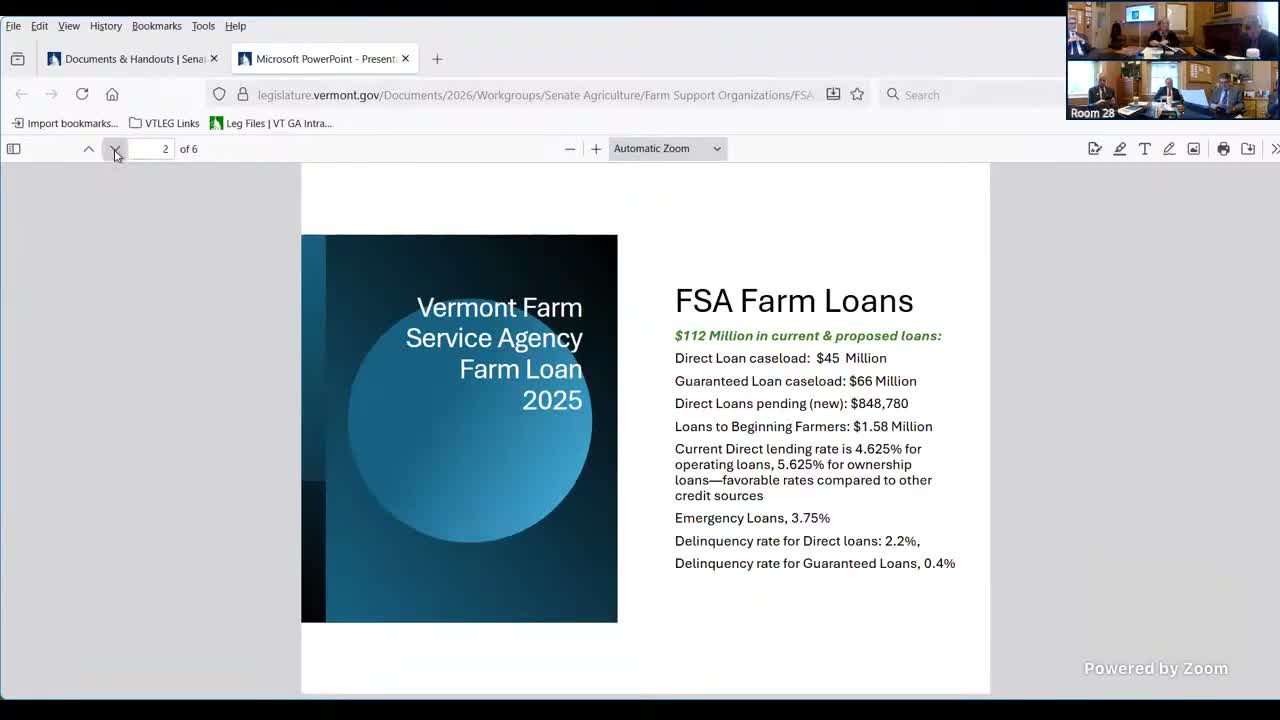
Summary
State FSA director Wendy Wilton told lawmakers FSA is a "lender of first opportunity," with about $112 million in loans statewide (roughly $45M direct, $66M guaranteed), a delinquency rate of ~2.2%, and emergency/disaster programs that have delivered millions to Vermont producers.
Wendy Wilton, State Executive Director of the USDA Farm Service Agency in Vermont, summarized FSA lending activity and disaster assistance in a legislative briefing. "We still have a pretty good caseload. And currently, we have about a $112,000,000 in loans," Wilton said, and she clarified that the portfolio includes both direct loans and guaranteed loans.
Wilton explained the split: about $45 million in direct loans and $66 million in guaranteed loans, with guaranteed lenders underwriting loans to FSA specifications and FSA providing a guarantee for larger credit needs. She described FSA’s role as helping beginning farmers who "may not be bankable" initially and noted that when a borrower becomes commercially creditworthy they typically "graduate" off FSA loans via refinancing or payoff.
On loan performance, Wilton reported Vermont’s FSA delinquency rate at about 2.2%, which she described as low compared with other states. She said recent reductions in direct operating loan interest rates make FSA lending competitive for beginning producers.
Wilton also outlined emergency loan and disaster assistance: drought conditions in 2025 and floods in 2023–24 triggered emergency loans and ad‑hoc relief programs. "To date, with these programs, we put out over $10,000,000 to Vermont farmers," she said, and noted $3,600,000 had already been distributed in phase‑one SDRP payments. Wilton said emergency loans are intended to be a rapid option for urgent needs such as drilling wells or covering feed costs, and that some actions can be reimbursed later through program funding.
Committee members asked about turnaround time for emergency loans and outreach to producers; Wilton said emergency loans can be processed quickly ("I won't say a week or 2, probably") but that larger direct loans with real‑estate collateral require a longer underwriting process.