Get Full Government Meeting Transcripts, Videos, & Alerts Forever!
Get email alerts on the Zoning Variance topic
No spam. Unsubscribe anytime.
Walker Zoning Board OKs 14‑foot Front‑yard Variance for Hillside Drive Loading Dock
Summary
The City of Walker Zoning Board of Appeals approved a 14‑foot variance (40'→26') for a loading‑dock addition at 2756/2765 Hillside Drive NW after a reconsideration vote, 4–1. The Planning Commission will review engineered truck‑turning templates and safety mitigation next.
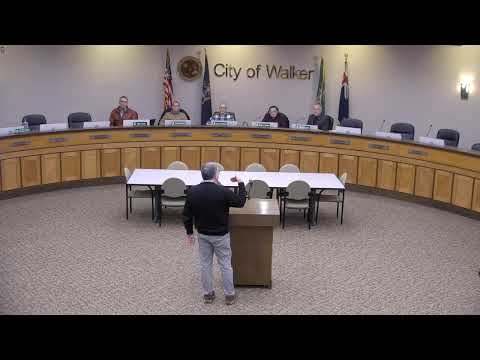
The City of Walker Zoning Board of Appeals voted 4–1 on Jan. 14, 2026 to grant a 14‑foot front‑yard setback variance for a proposed loading‑dock addition at a light‑industrial property on Hillside Drive, allowing the building addition to sit 26 feet from the front property line where the ordinance requires 40 feet.
Planning staff member Paula told the board the parcel is zoned I‑1 (light industrial) and that the request concerns section 7.01 of the zoning ordinance (the schedule of regulations). She warned that Hillside Drive retains a 100‑foot right‑of‑way from an earlier era and that the Pioneer Trail/White Pine State Trail runs on two sides of the property, making pedestrian and bicycle safety a key consideration.
“We’re asking for a 14‑foot variance,” Paula said, and if the variance is approved the project will return to the Planning Commission with fully engineered plans; the commission will require a truck‑turning template and review lighting, landscaping and other measures to show that the largest anticipated truck can make forward‑in movements safely.
The applicant, who introduced himself in the hearing as David Kropf and identified Dan Hula as the site engineer, said the dock is needed so trucks can drive onto the property and pull forward to load and unload instead of backing across the trail. “We need to expand this building in order to prevent us from not growing anymore or moving our entire business…so we can bring box trucks in and load our product,” he said, and estimated roughly three to five box‑truck movements per day if operations expand.
Several board members said forward‑in loading could reduce risky backing movements across the trail and improve visibility for drivers. One board member cautioned that “the proposed reduction does create a hazard” without documented mitigation such as cross‑markings, guardrails or warning signals, and noted that the packet did not include traffic or engineering studies demonstrating safe truck movements.
A first motion to find that the application met the four legal tests for a variance failed in a preliminary voice vote because the board did not register the four affirmative votes required to grant a variance. After discussion about whether trail safety details would be addressed later by the Planning Commission, a motion to reconsider passed, and the board adopted the variance on a 4–1 vote. The transcript records one member identified as John voting against the grant; the record shows four board members voting in favor.
The variance approval applies only to the 14‑foot front‑yard setback relief. If the variance is implemented, the project must come back to the Planning Commission for site plan and engineering review, where staff said truck‑turning templates and detailed mitigation measures will be required to demonstrate safe operations across the trail.
The applicant thanked the board after the vote and indicated he would proceed to submit the full engineered plans to the Planning Commission. The board discussion and final vote were recorded in the meeting minutes for Jan. 14, 2026.