Richmond leaders vote to seek temporary prohibition of special-use permits while planning board crafts objective criteria
Loading...
Summary
At a joint workshop, the town council asked staff to add to an upcoming agenda a proposal to advertise amendments to Chapter 18.16 to temporarily convert uses currently allowed by special use permit to prohibited so the planning board can develop objective, measurable criteria; the motion passed unanimously.
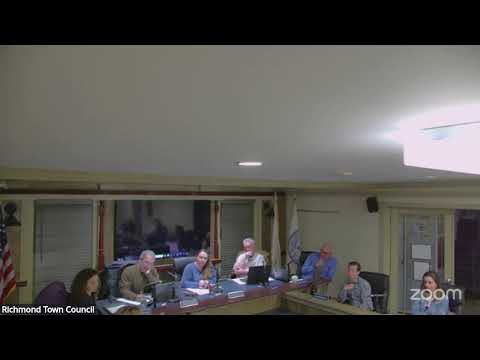
At a joint meeting of the Richmond Town Council and Planning Board, members voted unanimously to ask staff to place on the council’s next agenda a proposal to advertise amendments to Chapter 18.16 of the zoning use table that would temporarily convert all activities now allowed by special use permit into prohibited uses while the planning board develops specific objective criteria.
The motion was made by an attendee at the workshop (first recorded speaking at SEG 398) and seconded on the record (SEG 406). Planning staff and legal advisers told the group a direct ordinance could not be adopted tonight because the session was not noticed as a public hearing; instead, council can authorize advertisement to open a formal public hearing process (staff comment, SEG 361–376). Erin, a staff member who advised the group on process and cost, said routine advertising for zoning changes would require three weeks and likely cost “in the $700 to $1,000 range” for the required consecutive-week notices (SEG 655–657).
Why it matters: changes in state law have broadened the administrative officer’s role, allowing many minor land-development applications to be approved administratively without planning-board review, the planner read into the record (SEG 046–056). Several councilors and board members said that, without objective criteria, special-use-permit language can leave the town vulnerable to arbitrary outcomes: one member warned that applicants could propose widely varying buffer widths or other measures, producing inconsistent decisions (discussion, SEG 235–246). Converting the S-designation to prohibited temporarily would give the planning board the breathing room to develop measurable standards that could later return those uses to an S classification if warranted.
Details and next steps: the motion asks staff to prepare an advertisement for the council to authorize public notice and a public hearing on the proposed amendments. Planning board members signaled they will continue their workshops to draft objective criteria on prioritized topics including buffers, lot size, aquifer protection overlay standards and dark-sky compliance (planning board direction, SEG 763–776; SEG 933–976). Staff cautioned that scheduling and statutory timelines mean any effective change would likely not take effect until after required advertising windows and possible special meetings; one staff member said March or April was a reasonable target depending on workloads and applicant flow (SEG 1901–1905).
What was decided and what was not: the council’s motion was limited to asking staff to advertise the proposed text changes; no ordinance was adopted tonight. Legal staff and the planner explained that advisory recommendations from the planning board are advisory and not binding on the council (SEG 552–561, SEG 595–606). The motion passed with a unanimous recorded affirmation at the workshop (transcript note: “And, it’s unanimous,” SEG 751).
What’s next: staff will prepare the advertisement and proposed amendments for council consideration. The planning board will continue workshops to draft objective standards for the uses in question; the council will decide whether to authorize formal advertisement and a public hearing on the text changes at its next meeting. If the council authorizes advertising, statutory notice requirements mean the earliest effective dates will depend on the advertising schedule and any required public hearings.