Get Full Government Meeting Transcripts, Videos, & Alerts Forever!
Get email alerts on the Evidence And Jurors topic
No spam. Unsubscribe anytime.
Appeals court hears challenge to evidence and juror handling in Eddington case
Summary
At oral argument, defense counsel urged the Appeals Court to find insufficient evidence that Gerald Eddington was armed on second entry, to exclude a prejudicial 911 call as an excited utterance, and to rule that a juror exposed to an extraneous incident should have been removed; the panel heard opposing factual and legal arguments and submitted the matter.
The Appeals Court heard oral argument on claims arising from the trial of Gerald Eddington, where defense counsel pressed that the record lacks proof he was armed when he re-entered the home and that a pocketknife should not be treated as a per se dangerous weapon. "Assault once inside," counsel acknowledged as a factual assertion before the court, but added the evidence did not establish the weapon issue the way the Commonwealth contends.
Counsel also challenged the admission of a 911 recording, arguing the excited-utterance doctrine was misapplied and the tape should have been redacted because portions were not based on the declarant's personal observations. "Even the fact that she states that you have to arrest mister Eddington was not a statement that he actually committed the crime," defense counsel said during argument.
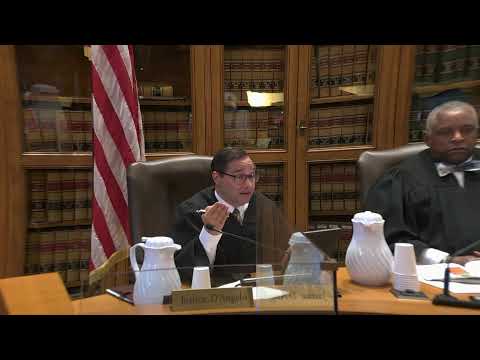
The panel asked pointed questions about whether vacating duplicative counts would require resentencing and whether the record supports removal of juror number 5 after an extraneous altercation outside the courthouse. The Commonwealth argued the voir dire and testimony permitted admission of the recording and that all jurors, including the challenged juror, stated they could be fair and impartial.
The court also discussed other preservation issues, including unpreserved claims about other-bad-acts testimony. Defense counsel acknowledged some claims were conceded below and submitted on a written brief. After questioning both sides, the panel submitted the matter for decision.
The court took no action at argument; the matter is under submission to the panel.