
Santa Cruz Council votes 6-1 to terminate Flock Safety ALPR contract, directs staff on safeguards
Get AI-powered insights, summaries, and transcripts
Sign Up Free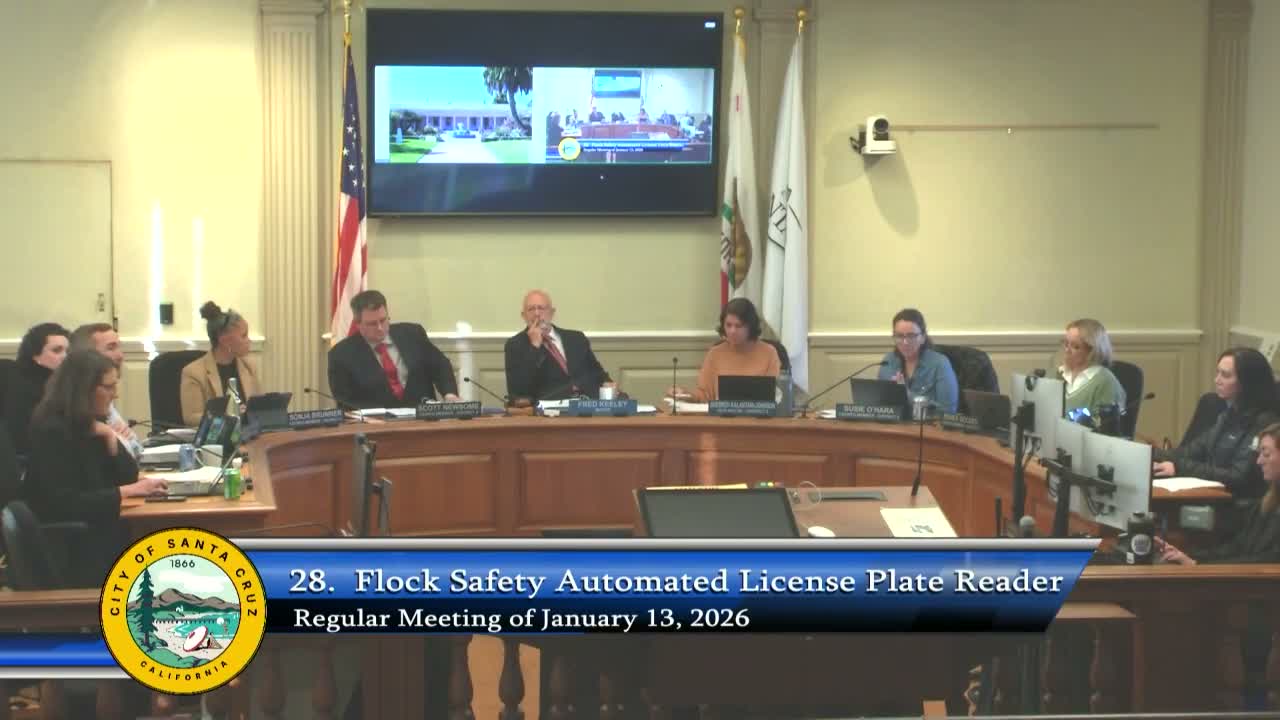
Summary
After hours of public testimony and council debate, the Santa Cruz City Council voted 6-1 to terminate its contract with Flock Safety and discontinue use of its automated license-plate readers effective immediately, directing the city manager and city attorney to provide notice and return with recommendations for any future ALPR use.
The Santa Cruz City Council voted 6-1 to terminate the city's contract with Flock Safety and discontinue use of its automated license-plate-reader (ALPR) system, citing security, data-sharing and vendor-accountability concerns.
Council member Susie O'Hara, one of three sponsors of the motion, opened the discussion by acknowledging that ALPR technology has helped the Santa Cruz Police Department (SCPD) in investigations but said the vendor's repeated operational and transparency failures and the present federal immigration enforcement climate raised unacceptable risks. "When the stakes are this high, the vendor's posture matters," O'Hara said, arguing that the city must not leave a plausible path for local data to be used in ways that conflict with Santa Cruz values.
Dozens of residents testified during a prolonged public-comment period. Peter Gelblum of the ACLU summarized the legal and policy case for cancellation: "Literally, the only way to protect the data from being misused is not to collect it," he said, and urged the council to disable cameras once the motion took effect. Community groups such as Get the Flock Out described technical vulnerabilities and alleged instances of misuse; Jill Clifton said the system "tracks and records nearly all the cars driving around these cities" and warned against replacing Flock with a similar vendor.
The Santa Cruz Police Officers Association opposed immediate termination. Josh Traug, the union president, called the system "a valuable investigative tool" that helps locate stolen vehicles, identify suspects and find missing people, and asked the council to preserve well-regulated access while strengthening oversight.
Police Chief Bernie Escaloni told the council the department had worked with Flock and city staff to add safeguards: disabling the national search tool in February 2025; revoking outside access for a California city that was still sharing data; implementing a statewide-sharing disablement and narrower reason codes; creating attestation forms for agencies requesting access; and producing network and organizational audits. He said Santa Cruz retains control of permissions and generally keeps Flock data for 30 days.
Council member Brunner offered a substitute motion to keep Flock while imposing stricter contractual and audit controls, independent quarterly review, and attestation requirements for access. That substitute motion failed for lack of a second. After extended deliberation, the council voted by roll call: Tragero Aye; Brunner No; Newsom Aye; Golder Aye; O'Hara Aye; Vice Mayor Kalantari Johnson Aye; Mayor Keeley Aye. The motion passed 6-1.
The approved motion directed the city manager and city attorney to provide the required notice to Flock Safety, discontinue the system's use effective immediately, and return with recommended approaches and safeguards should the city consider reinstituting ALPR in the future. Council members emphasized that the vote is meant to remove a vendor the council said it cannot trust while leaving open the option of future technology that meets strict, locally enforceable standards.
The council also discussed operational next steps recommended by speakers and members of the public, including covering or disabling cameras immediately after notice, ensuring powered cameras are secured to avoid lingering cybersecurity risks, and conducting audits of network and device security. Chief Escaloni said the department had already implemented several mitigations and offered quarterly audits and transparency portal updates.
The council's action follows months of local advocacy, litigation and national scrutiny of ALPR vendors and comes amid debate over the technology's privacy, security and civil-rights implications. Council members who supported termination stressed the city's role in protecting vulnerable community members, while the dissenting vote cited the technology's investigative value.
The council adjourned for a short recess after the vote and then continued with the rest of the agenda.