
Committee forwards EIFD to finance infrastructure for 3333 and 3700 California Street developments
Get AI-powered insights, summaries, and transcripts
Subscribe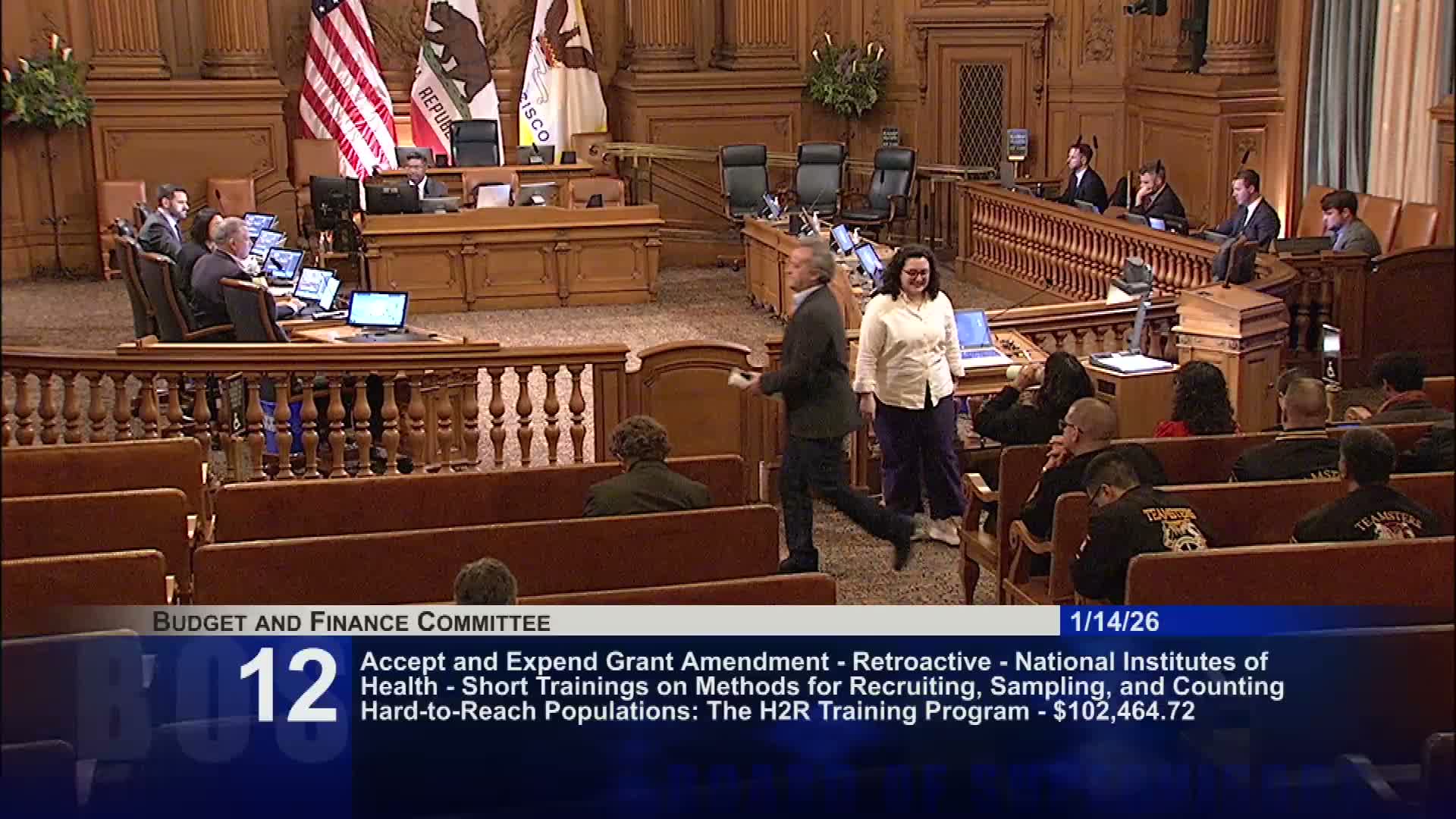
Summary
The committee advanced a resolution to form an Enhanced Infrastructure Financing District to capture incremental property tax for two California Street projects (3333 and 3700 California) to finance streets, utilities, open space and affordable housing; staff said 50% of net new property tax revenue is proposed for the district and a net fiscal benefit analysis was completed.
The Budget & Finance Committee on Jan. 14 voted to forward to the full Board a resolution approving an infrastructure financing plan (IFP) and formation documents for an Enhanced Infrastructure Financing District (EIFD) covering the 3333 and 3700 California Street projects.
Leigh Lutenski of the Office of Economic and Workforce Development told the committee the EIFD is intended to reimburse developers for site infrastructure (streets, utilities, parks) and to unlock delivery of more than 1,200 housing units across the two projects, including on-site and off-site affordable housing and community benefits. The IFP proposes allocating approximately 50% of net new incremental property tax revenues to the EIFD; staff said a net fiscal benefit analysis indicates the general fund will still benefit overall.
Public commenters included nearby residents urging more housing, housing advocates and construction-trades representatives who supported the district as a tool to accelerate housing production and job creation. The committee recorded a 3-0 vote to refer the resolution to the full Board.
Staff noted the EIFD formation is followed by a public financing authority vote and that reimbursements only occur after developers expend and validate eligible costs.
The EIFD authorizes a 40-year tax-increment period and includes a "use it or lose it" requirement to encourage timely Certificates of Occupancy within 10 years, per city EIFD policy.