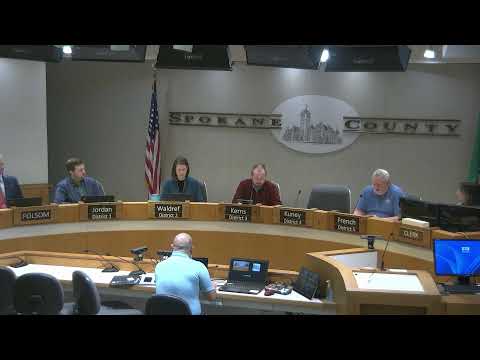
Spokane County adopts higher public-works fees, phases increases over three years
Loading...
Summary
After a staff presentation noting fees had not been updated in a decade or more, the Spokane County Board of County Commissioners unanimously approved amendments to public-works fees and Spokane County Code chapters 3.2, 8.03 and 9.14 on Jan. 13, 2026, with several increases phased in over three years to ease the transition for developers and permit applicants.
The Spokane County Board of County Commissioners unanimously approved amendments to the county’s public-works fee schedule and corresponding changes to Spokane County Code chapters 3.2, 8.03 and 9.14 at its Jan. 13, 2026 legislative meeting.
Public Works presenter Matt Zaracore told commissioners the county’s fees “have not been updated in excess of 10 years, some of them 15 years,” and said two factors drove the proposal: constrained, restricted revenues and limitations in the county’s new Workday system that make hourly billing impractical. Zaracore added that, as proposed, the road fund currently subsidizes the county’s fee structure “to the tune of about $1,000,000 a year.”
The staff presentation outlined increases across several areas. Planning fees would be raised and shown alongside public-works fees to compare the county’s charges with those of the City of Spokane and Spokane Valley; Zaracore said the combined figures place Spokane County roughly within the peer range. Land-development review fees—covering road and drainage plan reviews, grading, drainage and utilities—were also increased. To soften the impact, staff proposed a three-year phase-in for planning and land-development review fees.
Right-of-way fees were described as being essentially doubled under the proposal, with inspections folded into the fee rather than charged separately. Zaracore discussed swale bonds and urban approach bonds but said the county did not intend to require those bonds initially because they tie up builders’ cash and often fail to fully cover mitigation costs; instead, he said a better approach is to tie mitigation to occupancy, a change supported by the building department. When Commissioner French asked whether the “$200 times swale length” charge was by inch, foot or mile, staff confirmed the fee is calculated by foot.
Zaracore said proposed floodplain fees would rise substantially for mapped floodplain work while common, quicker office reviews would remain at lower rates; elevation-certificate and as-built fees were retained to collect required post-construction documentation. Sewer-related fees, including pretreatment and mainline review charges, were also increased; staff noted that adding application fees to the proposed rates often doubled current charges and reflected the county’s goal of recovering the full cost of reviews.
After the staff recommendation to adopt the fees with a phased implementation, the board took public testimony; no members of the public spoke on the item. A motion to approve the fee amendments and corresponding Spokane County Code changes was made, seconded and approved unanimously by the commissioners.
Votes at a glance: the board approved a consent motion earlier in the meeting to adopt items 3 and 4 (voice vote, 5–0), and later approved the public-works fee amendments and code amendments (voice vote, unanimous). The amendments take effect as presented, with phased increases for specified planning and land-development fees.
Details cited during the meeting include a $1,000,000-per-year subsidy from the road fund toward current fee shortfalls, a proposed three-year phase-in for planning and land-development fees, right-of-way fee increases with inspections included, and a confirmation that a swale charge of $200 is assessed per foot. The board did not make additional changes to staff’s recommendations at the meeting.
The board concluded the item and moved on to additional housekeeping and executive-session items.