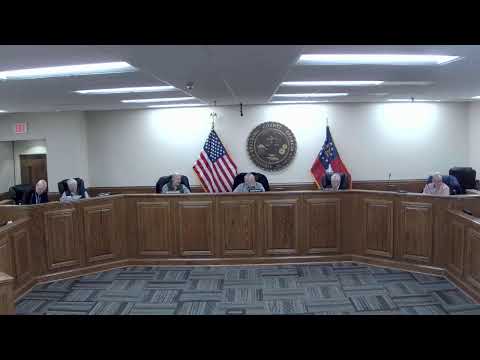
Spalding planners recommend approval for Wallace Jackson data‑center campus amid heavy public opposition
Loading...
Summary
The Planning and Appeals Commission voted Jan. 12 to recommend approval of a variance, rezoning and special exception for a proposed Wallace Jackson data‑center campus on Jackson Road, while dozens of residents warned the project would harm wetlands, strain roads and consume large amounts of water.
The Spalding County Planning and Appeals Commission voted Jan. 12 to recommend to the Board of Commissioners approval of a three‑part application from Wallace Jackson LLC that would allow a large data‑center campus on parcels off Jackson Road.
The commission approved a variance to allow data‑center development in small portions of S‑2 and S‑4 watershed/wetlands protection overlays, voted to recommend rezoning the property from C‑2 to C1C and recommended a special‑exception permit for a data‑center campus. Commissioners approved the variance with staff‑recommended conditions and forwarded the rezoning and special‑exception items to the Board of Commissioners for final action.
Why it matters: Speakers at the meeting described the proposal as a potential economic windfall — the applicant’s DRI documents estimate a full build‑out value of roughly $3.65 billion and an annual ad‑valorem tax impact of about $51.6 million — but dozens of nearby residents said the project threatened local waterways, property values and rural character and asked the commission to deny the requests or require far more technical detail before advancing the project.
What the applicant said: Steven Jones, attorney for the applicant, told the commission the parcels are already zoned for industrial uses and that the proposal is a down‑zoning to C1C for a data‑center campus. Jones said the concept plan includes 100‑foot undisturbed buffers and 50‑foot impervious setbacks where perennial streams exist and that wetlands would be field‑located and addressed during engineering and permitting. “All the state and federal laws with respect to the wetlands will be addressed,” Jones said, adding that the team had discussed potential FAA review for taller structures and intended to comply with required permits.
What opponents said: Dozens of residents urged denial or further study, raising technical and process concerns: the lack of detailed water‑use and traffic studies in the packet; the potential for contaminants from closed‑loop cooling systems; and cumulative impacts from other nearby industrial projects. “The proposed data center totals 4,000,000 square feet,” said resident Greg Burns as a way to convey scale; other speakers cited still larger totals for the entire campus. Multiple residents asked who would supply the large amounts of water the project might require and whether road improvements and funding responsibilities had been resolved.
Staff recommendation and conditions: County staff recommended approval of the variance on the basis that the concept plan shows required S‑2 buffers and S‑4 wetland avoidance measures and that wetlands would be surveyed and, if disturbed, addressed through U.S. Army Corps of Engineers permitting (Section 404) as necessary. Staff advised commissioners that the variance, should it pass, would accompany the rezoning and special‑exception actions when the Board of Commissioners considers the package.
Outcome and next steps: The commission approved the variance (one recorded opposition) and recommended approval of the rezoning and special exception; the items now go to the Board of Commissioners on Jan. 22 for final decisions. The commission’s approval included staff‑recommended conditions concerning buffers, setbacks, wetland delineation, adherence to FAA or other applicable agency requirements and compliance with county stormwater and road‑improvement conditions that will be reviewed at engineering‑plan stage.
What remains unresolved: Residents and several commissioners asked for more information about power supply, detailed construction phasing, traffic impacts during a projected multi‑year build‑out, and the exact water‑use and cooling strategies that will apply to the data‑center campus. The record contains differing size estimates cited by speakers; the commission’s action is based on the submitted concept plan and staff conditions rather than a final engineering package.
The Board of Commissioners is scheduled to hear the rezoning, variance and special‑exception recommendations on Jan. 22 in the same meeting chamber.