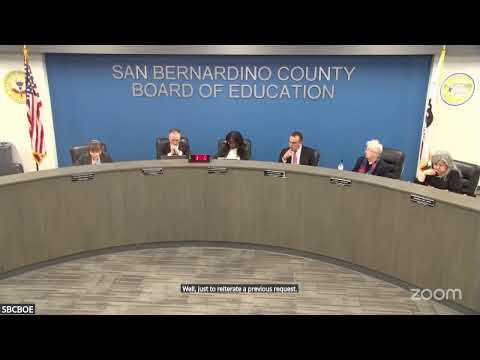
Board members debate minutes detail, communications policy and special‑education compensatory language
Loading...
Summary
Trustees at the Jan. 12 meeting debated how detailed minutes should be, whether staff presentations should be summarized, and proposed changes to an electronic‑communications policy. Members also approved an emergency attendance waiver (Form J‑13a) with follow-up to clarify compensatory education provisions for special‑education students.
San Bernardino County Board trustees spent significant time on Jan. 12 discussing the format and accuracy of official minutes, the county board’s electronic‑communications protocols, and how the superintendent’s office handles special‑education make‑up services for days lost to emergency closures.
Several trustees said current minutes omit substantive board discussion, factual figures and questions from members, making it harder to prepare for subsequent meetings. Others said statutory requirements for minutes are modest—primarily recording actions and roll‑call votes—and pointed out that meetings are video‑recorded and available as verbatim records. Counsel explained the Brown Act does not mandate deposition‑style minutes and that vote tallies are the legal minimum; the board may adopt a more detailed internal standard at its discretion.
The board also reviewed a draft electronic‑communications policy to clarify how public messages addressed to a county inbox should be routed and whether the board should rely on SBCSS acceptable‑use agreements. Members asked counsel and staff to refine the draft and return it for a formal reading. Several trustees requested a notification step when staff routes an email away from the board or declines to forward it.
On an emergency attendance matter (Form J‑13a), the board voted to approve the waiver to allow state reporting for days lost to emergency conditions. Trustees asked staff to confirm, in writing and with legal review, how compensatory services required by IEPs will be addressed; special‑education staff said students would receive increased instructional minutes and targeted make‑up services consistent with compliance obligations.
The discussion concluded with several board members requesting future agenda items that include auditor selection policy language, potential refinery of minutes procedures, and statutory guidance on Form 700 filing and the role of the filing officer.