
UC Davis proposes three-year oxygenation pilot on Clear Lake’s Oaks Arm to curb harmful algal blooms
Get AI-powered insights, summaries, and transcripts
Subscribe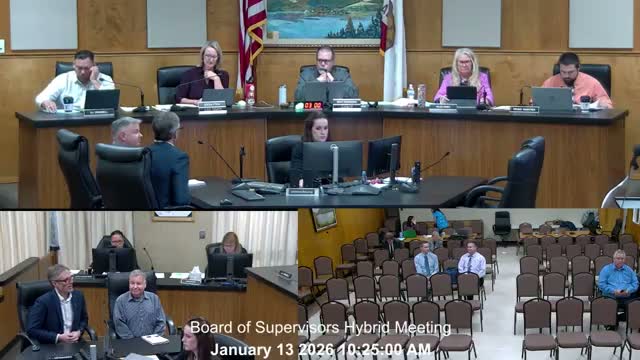
Summary
UC Davis told the Lake County Board of Supervisors it plans a three-year hypolimnetic oxygenation pilot in the Oaks Arm of Clear Lake to reduce internal phosphorus release driving harmful algal blooms, with EPA funding, an expected CEQA exemption and estimated annual operating costs of about $500,000–$600,000.
UC Davis told the Lake County Board of Supervisors that it plans to deploy a three-year hypolimnetic oxygenation system (HOS) in the Oaks Arm of Clear Lake this summer, as a pilot to reduce internal phosphorus release that the university says drives summertime harmful algal blooms.
The university’s lead presenter, Professor Alex Forrest of UC Davis, told supervisors that monitoring and modeling by UC Davis and USGS indicate roughly 70% of the phosphorus fueling blooms in summer comes from internal loading — phosphorus released from lakebed soils when bottom oxygen is depleted during seasonal stratification. "About 70% of the phosphorus in the lake every summer is coming from this process of what we refer to as internal loading," Forrest said.
Why it matters: Harmful algal blooms have caused fish kills and raised water-quality concerns for water districts and cultural uses around the lake. UC Davis said the HOS is designed to inject oxygen near the bottom to prevent that internal release of phosphorus, and to be remotely controlled and monitored so turns of the system align with stratification and wind-driven mixing.
Project details and partners: Forrest said UC Davis has partnered with the Tahoe Environmental Research Center, the U.S. Geological Survey and other watershed partners to map bathymetry, deploy moorings and run stream-load studies. The pilot will target the Oaks Arm, use distributed observation buoys to track oxygen and nutrient response, and run for a three-year operational period subject to permitting. "We're targeting an operation of the system for 3 years," Forrest said.
Permits, funding and cost estimates: Project staff told the board they are seeking a CEQA exemption because the effort is a limited-duration scientific study and that permits are in progress for land- and in-water work. Forrest and staff said the EPA has provided funding support for the project. The total project budget was discussed as about $5,000,000, and staff estimated annual operating costs after procurement at roughly $500,000–$600,000, pending bid results and measured oxygen demand.
Board concerns and next steps: Supervisors and members of the Blue Ribbon Committee pressed for clarity on long-term sustainability if the pilot succeeds. Supervisor Crandall warned the county could be left “holding the bag” if no operator is identified after the pilot; project staff said they are seeking a local partner — likely a water district that holds land — to take over operations if continuation is desired. Forrest also proposed a common monitoring strategy so multiple pilot technologies can be evaluated on an equal basis.
Public comment and alternatives: A public commenter, Sterling, urged the board to consider dredging contaminated sediments rather than a recurring aeration approach and raised risks that changes in chemistry might increase methylmercury. Sterling also highlighted septic systems and winery runoff as external nutrient sources. Forrest and supervisors agreed the response requires both near-term mitigation (to prevent fish kills) and longer-term watershed solutions to reduce external loads.
What happens next: UC Davis said it aims to be operational this summer if permits are approved and will return with updates; if permits or design delay the schedule, the team said it could defer deployment to the following year. Forrest offered to propose a common monitoring recommendation to the supervisors so that all pilot technologies can be compared on the same metrics.
The presentation concluded with the board thanking UC Davis and noting continued oversight through the Blue Ribbon Committee and follow-up with county staff.