
Parents and students urge Vancouver School District to reverse plan to close Flex Academy (Lehi)
Get AI-powered insights, summaries, and transcripts
Subscribe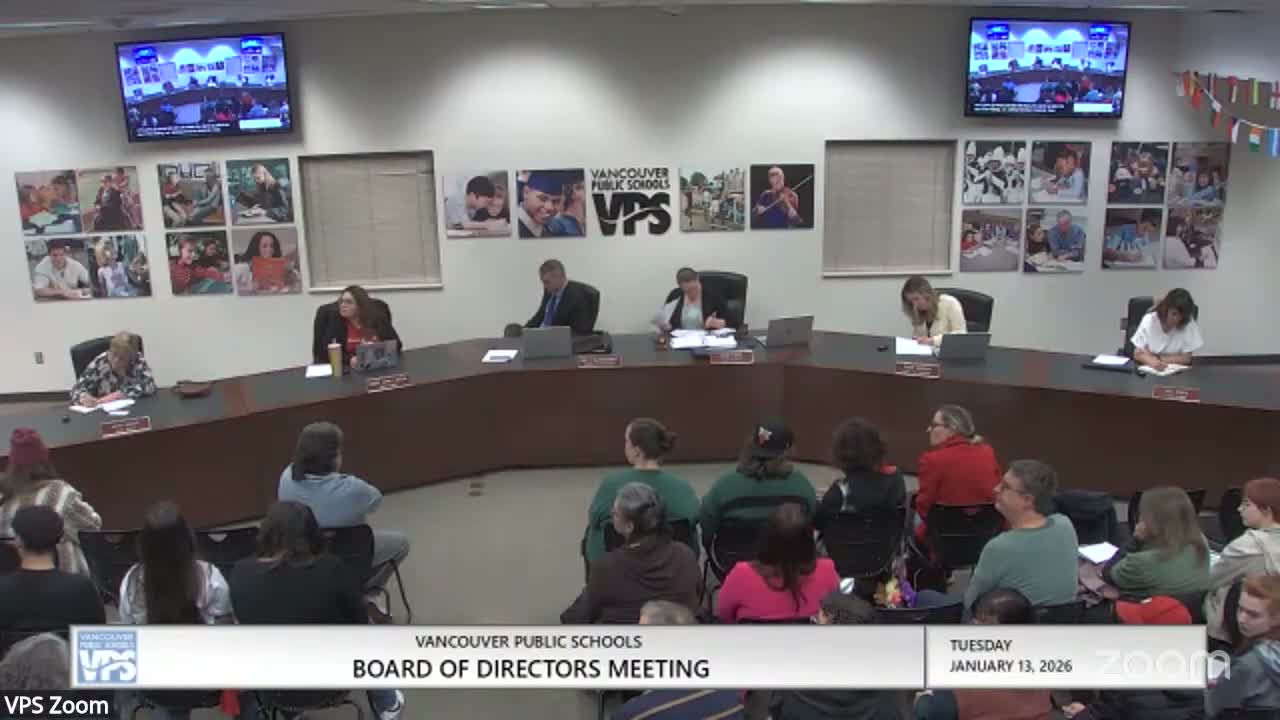
Summary
Dozens of parents, students and staff told the Vancouver School District board the planned closure of Vancouver Flex Academy (Lehi) was handled poorly and will remove a legally necessary, effective placement for many students with disabilities. Speakers urged the board to pause and find alternatives.
Dozens of parents, students and staff packed the Vancouver Public Schools boardroom on Jan. 15 to plead with trustees to reverse or pause the district's decision to close Vancouver Flex Academy (commonly called Lehi).
"Flex was a godsend for us," parent Bruce Anderholt told the board, saying his freshman daughter's horticulture and ASL programs and the small-class environment helped her thrive. Anderholt said the closure appeared to have been announced as a "fait accompli" and that required steps under IDEA and FAPE, including prior written notice and individualized consideration of alternatives, had not occurred.
Several parents recounted similar experiences. "My son is autistic," Erin Stepanek said. "Before Flex Academy, school was not a place of learning for him. Closing Flex Academy is not a neutral decision for students with IEPs. It is a removal of placement that is working." Stepanek said she was not consulted and did not receive prior written notice.
Students spoke as well. Avila (Abigail) Reynolds, a Flex student, said the school is the only environment where she can learn and that classmates had told her they felt suicidal at the thought of losing Flex. Parents and clinicians warned of serious mental-health consequences if the school closed without careful transition planning.
Board members heard repeated assertions that the district's proposed alternatives are not comparable. Jenny Reynolds said options outlined in district communications (part-time or virtual models like VLA and short-day STAR programs) would not replicate Flex's full-day, multi-staff instructional model. Multiple parents asked the board to house any new programs at the Lehi site so students could retain a familiar environment.
Advocates and specialists described Flex as a school that served a high proportion of students with disabilities and complex needs and noted measured student outcomes. April Pineda, a nonprofit director and parent, said district materials and past district messaging had treated Flex Academy as a stand-alone school and argued Washington state's regulatory definition (publicly financed instructional site) supports that status.
At least one public speaker acknowledged district fiscal constraints. Larry Rowe noted the district carried a general fund deficit ($5,600,000 cited for last year) and said the legislature's funding limits constrain local options. Yet many parents and community members challenged the choice to cut Flex rather than other budget lines and urged the board to identify alternatives that do not dismantle an effective placement.
The board did not respond to public comments during the meeting; the chair said staff would follow up with commenters after the meeting. Trustees recessed the meeting and indicated business items would resume outside the public boardroom.
What happens next: speakers asked the board to slow the closure process, engage directly with families and staff, and provide detailed, individualized transition plans for affected students; the board said it will follow up with people who spoke.