
Oregon official describes 'Orgo' road-usage charge to Vermont Senate, urges public outreach and vendor testing
Get AI-powered insights, summaries, and transcripts
Subscribe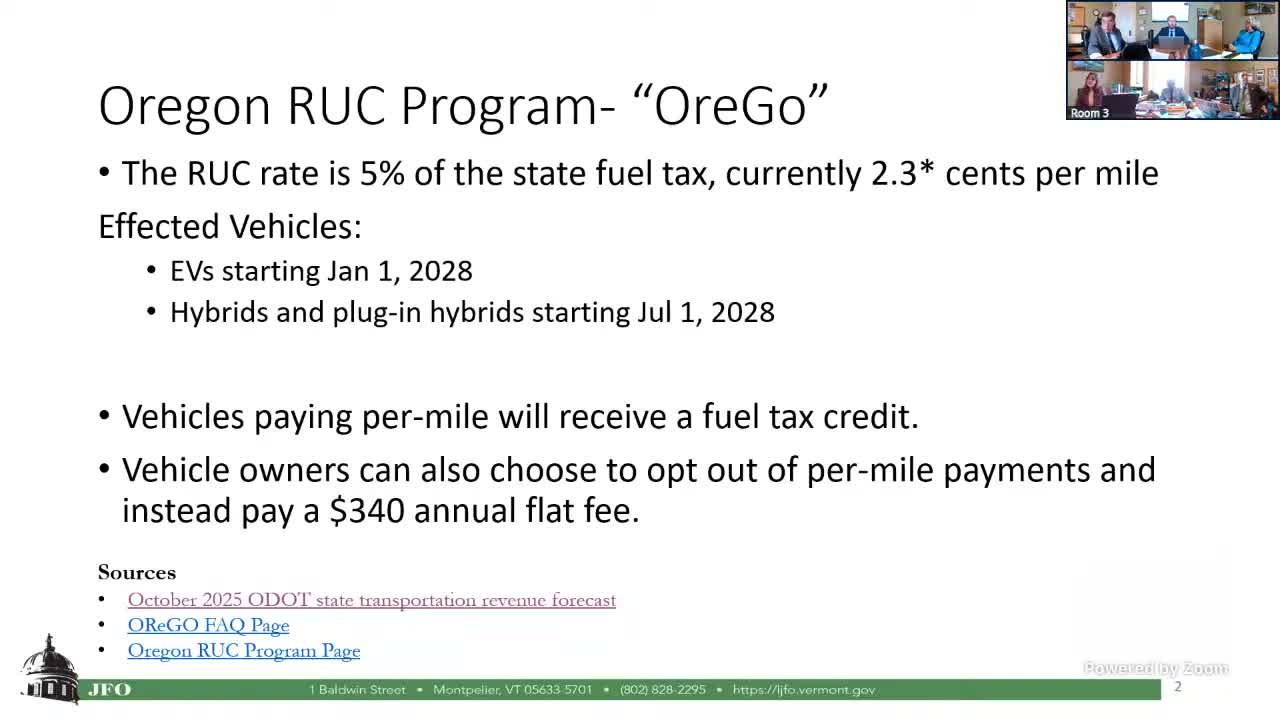
Summary
An Oregon presenter outlined the state's pay-by-the-mile road-usage charge (branded "Orgo"), saying it is intended to supplement — not replace — fuel-tax revenue, that participants may report by GPS device or odometer or pay an opt-out fee, and that data retention is limited by law; Vermont senators asked about verification, costs and equity.
An Oregon transportation official told the Vermont Senate Transportation Committee on Jan. 14 that Oregon's road-usage charge program, branded "Orgo," was designed to capture revenue from highly efficient vehicles and put them "on parity with inefficient vehicles," not to replace the state's fuel tax.
Maureen (presenter), representing Oregon's RUC implementation team, said the program was set by statute at a 5% rate of the state fuel tax and that the program design offers multiple reporting choices: GPS/telematics-enabled devices, odometer/photo-based reporting with annual attestation and refund mechanisms, or a flat annual opt-out fee. She said Oregon also credits fuel tax payments against road-usage charges so participants are not charged twice.
"It was to basically capture revenue from highly efficient cars and put them on parity with inefficient vehicles," Maureen said, describing the program's intent. She added that the fuel tax remained "a very steady state source of revenue for Oregon" and that legislators had pledged that revenue to repay bonds.
Committee members pressed for operational details: how mileage is verified, how account managers operate, and who pays administrative costs. Maureen said third-party "account managers" contract with the state to provide devices, customer service and billing; the state pays account managers and then receives net revenue quarterly. She said program start-up costs were substantial (devices historically cited as about $100 apiece and system-development costs significant), but that administrative costs decline as enrollment scales.
On privacy, Maureen said Oregon's statute and program rules required choices for participants so that travel-pattern data were not retained unnecessarily. "The legislature was very uncomfortable about both the state and private companies having this travel pattern data for long periods of time," she said, adding that data held for accounting or contested cases must be destroyed 30 days after payment or resolution and that the state audits account managers for compliance.
The presenter described technical elements the committee flagged as relevant to Vermont: geofencing every U.S. state and Canadian province to generate jurisdictional identifiers for in-state miles, certification testing of vendor devices (including geofence accuracy), and the rationale for maintaining multiple certified account managers to encourage competition and better user experience.
Maureen provided enrollment and policy context: Oregon reported roughly "900 plus" participants in the voluntary program; a planned mandatory phase that would have brought EVs into the program in 2028 was put on hold after a petition drive and subsequent gubernatorial request to repeal last year's transportation package so the legislature could revisit the entire funding plan.
Committee members also asked about distributional effects and vehicle-weight treatment. The presenter said heavy vehicles are already subject to a separate weight-mile program for vehicles over 26,000 pounds and that the Oregon RUC focused on passenger vehicles (under ~10,000 pounds), which engineers judged impose similar pavement damage within that class.
Maureen offered to share vendor contact names for Vermont staff and encouraged the committee to perform listening tours and public outreach before any launch: "Talk in public," she said, noting that public meetings shaped Oregon's messaging and branding.
The committee did not take any formal votes during the session. The presenter's written materials and the National Cooperative Highway Research Program (NCHRP) guide were cited as reference resources for jurisdictions considering RUC.