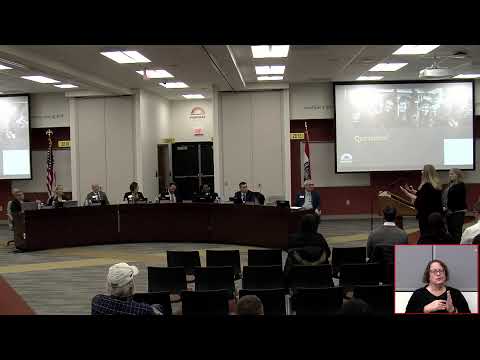
Parkway board hears budget task force warning, approves new early‑childhood site name
Loading...
Summary
The Parkway Board of Education on Jan. 14 received a budget task force report urging protection of a 40–45 percent fund balance, stabilization of rising health‑care costs and community engagement as the district prepares preliminary budget actions; the board approved routine agenda items and named the new center Early Childhood South Mason.
The Parkway Board of Education on Jan. 14 received a firm warning from a district budget task force that a combination of revenue constraints and rising benefit costs could push the district toward deficit budgeting unless leaders "protect our fund balance," Superintendent Dr. Morissa Schneider said.
The task force — a group of roughly 30 staff and employee‑group representatives convened over six sessions — recommended four priorities: maintain a 40 to 45 percent operating fund balance, stabilize health‑care costs, seek creative offsets for projected revenue losses and engage the public with a validated community survey as the district designs next year’s budget.
"Please protect our fund balance," Dr. Morissa Schneider said while presenting the task force’s conclusions and recommendations. The group presented scenario work showing the district’s fiscal picture, asked the board to preserve reserves to avoid short‑term borrowing, and outlined steps to reduce the chance of returning to tax‑anticipation notes.
CFO Carrie Nunn told the board the district is highly locally funded and sensitive to changes in property tax revenue. "For FY26, we are 92 percent locally funded," Nunn said, noting roughly 83 percent of local receipts come from property taxes. She outlined assumptions that feed the preliminary budget, including a forecasted 5 percent benefits increase for 2027 and a potential $3 million transfer from operations to the self‑funded insurance bucket to shore up medical reserves.
In response to questions about what a short‑term borrowing scenario would cost, presenters gave a concrete example. One month of Parkway payroll and benefits is about $17.1 million, and at current market rates a tax anticipation note could carry 2–4 percent interest — roughly $600,000 in interest for a one‑month borrowing in that scenario, presenters said.
The presentation stressed legal limitations on moving some funding between "buckets" (for example, bond funds cannot be repurposed for operating costs) and described capital plans funded by voter‑approved Prop S, including renovations and bus replacements.
Several teachers who testified during the public‑comment period framed the budget discussion in human terms. "We are the professionals that make all the other professionals," teacher Scott Moller said, urging sustained investment in educators. Russ Beckman, a Parkway parent and teacher at an alternative high school, said many colleagues hold second jobs to make ends meet. "Being a teacher shouldn't come with a second job," Beckman said.
Board members pressed staff on next steps. Task force members and district communications staff recommended using the district's Feb. 4 "State of the District" event and a professionally validated public survey to gather community priorities before the board considers final budget choices. The timeline presented by finance staff calls for generating departmental budgets after the board approves budget assumptions and returning a preliminary budget for board review in May, with final approval planned for June.
On routine business, the board moved and approved the meeting agenda and the consent agenda (each reported as 6–0). The board also approved the recommended name for the new early‑childhood center at 2100 South Mason Road: Early Childhood South Mason (reported 6–0).
Board members acknowledged that the legislative session in Jefferson City could change assumptions used in the forecast and said staff should be prepared to pivot if state action affects local funding. The district will continue monitoring state and federal grant guidance — presenters said some federal reimbursements (Title funding) were expected to be reduced and that final figures may not be confirmed until state platforms (ePEGS) publish budgets later in the year.
The board set procedural next steps: use community engagement this spring to inform budget choices, produce the preliminary budget in May and watch for legislative changes that could alter assumptions. The next regular board meeting is scheduled for Feb. 18 at 7 p.m. at the Parkway Welcome Center.