
Fire and EMS report: response times meet goals generally; National EMS enters Blue Cross Blue Shield network
Get AI-powered insights, summaries, and transcripts
Sign Up Free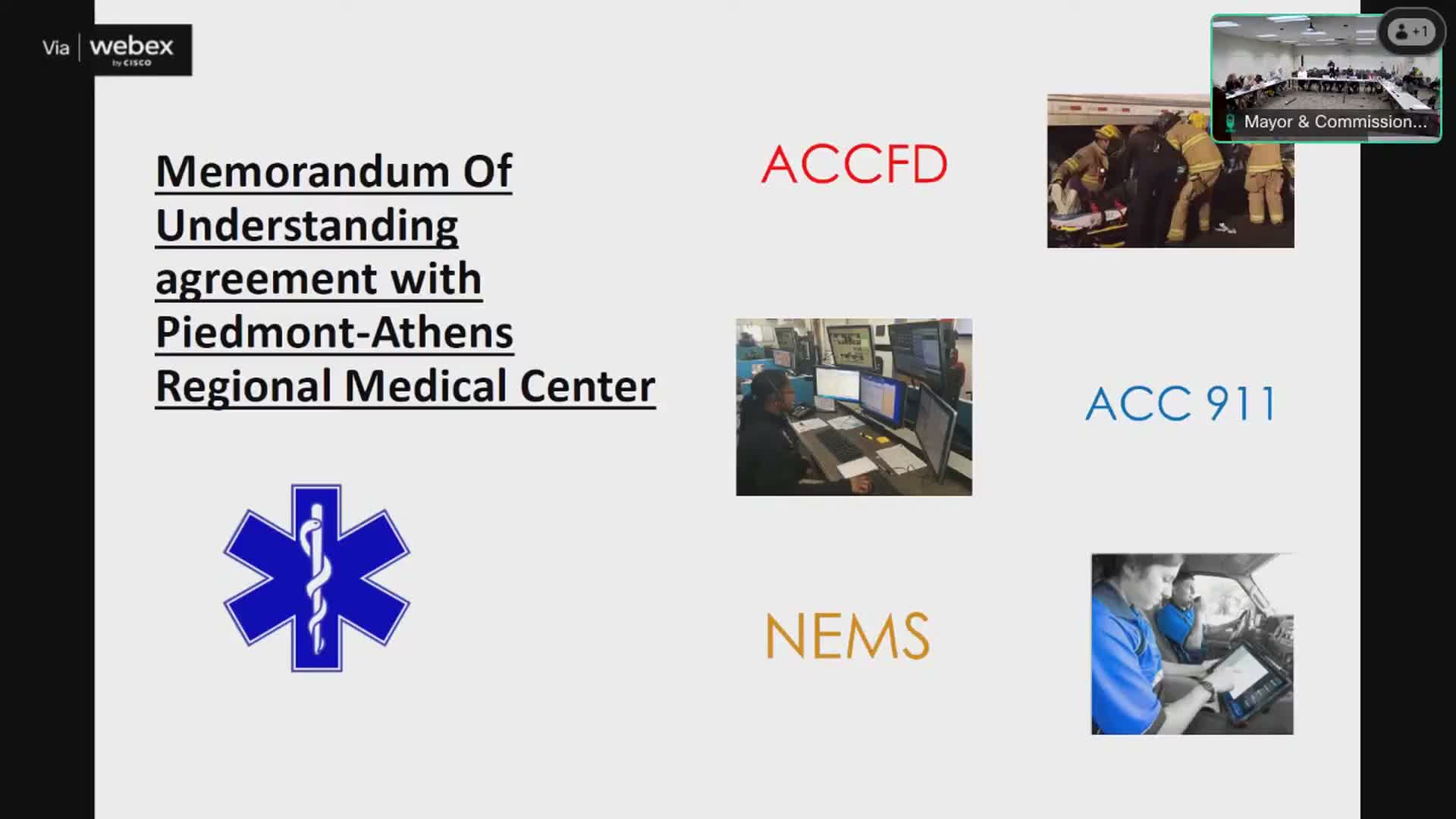
Summary
Fire and National EMS presented Q1 FY26 (July'Sept 2025) performance data: fire response metrics largely met local goals, average fire response was 4:45 and 90th-percentile near 7:41; National EMS reported 24 vehicles in service, recent inclusion in Blue Cross Blue Shield network, and noted 12 instances in the period when no ambulance was available; commissioners requested raw timestamps and staffing rosters for paramedic coverage verification.
Athens-Clarke County fire and contracted ambulance provider National EMS presented semiannual performance metrics for Q1 FY26 (July through September 2025).
Fire department: the fire chief reported apparatus inventory and distribution, including nine engines, three aerials and specialized units, and said 90% of fire responses met the target under 9 minutes; the 90th-percentile response time was reported at about 7 minutes 41 seconds and the average response time 4 minutes 45 seconds for the period. The chief noted that system-saturation events were rare (one period with 13 apparatus occupied for 22 minutes) and that reporting separates turnout time (dispatch to en route) from travel time so staff can target improvements.
National EMS: Tracy Laflamme, National EMS operations manager, said the provider operates 24 response vehicles in the system (including QRVs and transporting ambulances) and reported an overall average response time of roughly 6 minutes 37 seconds for priority calls in the service area; she noted the service entered the Blue Cross Blue Shield network on Sept. 1 and expects other payers to follow. Laflamme also reported system-capacity indicators: 12 occasions during the period where no ambulance was available to respond (all ambulances on calls), and several concurrent incidents where multiple ambulances were in service.
Dispatch and data: ACC 9-1-1 staff explained the CAD workflow: dispatch sends call data concurrently to ACC dispatch and National EMS (no phone transfer); ACC dispatch remains the EMD contact and provides pre-arrival instructions to callers. Commissioners requested the raw incident-level timestamps (time National is notified, times units become en route and on scene) as previously provided; staff and National EMS agreed to share those data even though they are not currently required by the MOU.
Paramedic staffing: commissioners asked whether National ambulances always carry a paramedic. Laflamme said ALS-designated vehicles are staffed with paramedics as scheduled and invited commissioners to review staffing rosters; National offered to make schedules available for verification.
Next steps and follow-ups: staff agreed to provide requested raw data and to continue work on reporting clarifications and dashboard improvements. No change to operational responsibilities or MOU terms were approved at this meeting.