Consolidated Fire District No. 1 reports staffing gains, equipment upgrades and technology shifts to Douglas County commissioners
Loading...
Summary
At a Jan. 14 Douglas County work session, CFD 1 leaders said 2025 saw 990 incidents and described hiring, recruit classes, equipment testing, a NEARIS reporting transition and plans to standardize SCBA and improve station infrastructure to boost response reliability.
Douglas County Board of County Commissioners — Consolidated Fire District No. 1 leaders told county commissioners on Jan. 14 that the department has stabilized staffing, advanced a recruit pipeline and is pursuing equipment and technology changes aimed at improving response across the district's roughly 228 square miles.
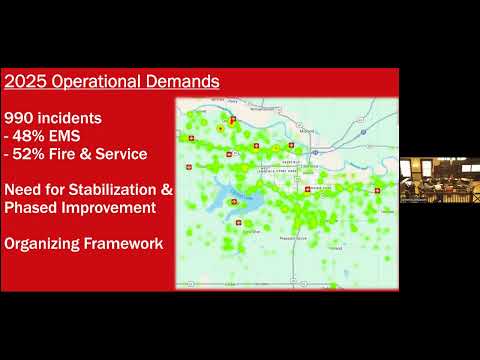
Chief Mathis said the district handled "990 incidents" in 2025 and described a roughly even split between EMS and fire/wildland calls — 48% EMS and 52% fire or service calls — which he tied to the district's rural and wildland response responsibilities. He said response drives are long in places: "Response time from Station 151 to Eudora is 26 minutes" and from Station 111 to Lecompton about 22 minutes, underscoring coverage challenges.
The presentation outlined recent staffing moves and recruiting progress. Mathis introduced new assistant chief Clint Hornberger and administrative staff Kirsten Rhodes and said the roster now lists 75 active members including full‑time staff and volunteers. He said 20 people from recent recruit classes are in process, with eight recruits completing Firefighter I and Kansas basic EMT and being promoted to firefighter/EMT status. Mathis said the district has hired two full‑time firefighters recently and plans to add additional full‑time positions to stabilize daily staffing at stations.
Why it matters: Commissioners and staff noted that call density and long drives change what resources are needed. Sean (county staff) framed the strategic approach as a set of pillars intended to "stabiliz[e] staff" and then address foundational improvements such as training, procedures and equipment standardization.
Equipment and facilities: Mathis said CFD 1 contracted Firecat to test hose and ladders and had "28,000 feet of hose" and ground ladders tested in October. The district is evaluating SCBA replacement and interoperability, discussing moving to 5,500‑PSI packs to align with Lawrence and other county departments. On facilities, Mathis said station signage was installed at six stations, noted the residency (living arrangements) program was discontinued in Q3, and identified deferred maintenance needs and a backup generator at Station 151 as priorities.
Technology and reporting: Staff described a migration from Google Drive to SharePoint for records and internal collaboration and efforts to improve station radio signals and Internet connectivity. Mathis said the district uses a pager/app redundancy with Life360/Life360‑style and phone apps to ensure volunteers receive dispatch notices even if Internet service fails. Mathis also highlighted NEARIS, "a new national incident reporting system" that took effect Jan. 1; he said NEARIS will change report writing to produce more queryable data useful for planning and white papers.
Commissioner questions and county support: Commissioners asked whether any stations are slated for closure or consolidation; Mathis said there are no plans to close stations but that maintenance and future use will be guided by where active volunteers live and which units are used. On funding and county services, county staff said CFD 1 pays fleet maintenance through its mill levy, the county performs HR/payroll and some IT assistance without overhead charges, and purchases such as software or dedicated fiber would be charged to CFD 1.
Recruitment and outreach: The presentation and discussion stressed the geographic mismatch between where volunteers live and where calls are concentrated. Mathis and staff described recruitment as partly organic (word‑of‑mouth) augmented by branding and outreach — signage, social media, "touch‑a‑truck" events and ride‑alongs — and operational changes to accelerate training and certification for recruits.
What comes next: Commissioners encouraged CFD 1 to flag unfunded state or federal mandates that could affect operations for potential advocacy. Mathis said apparatus and standards reviews are ongoing and that chiefs' meetings (bimonthly) provide a forum for county‑wide coordination. The work session adjourned ahead of the 5:30 p.m. business meeting.
Sources: Presentation by Chief Mathis and county staff during the Douglas County Board of County Commissioners work session on Jan. 14; transcript excerpts include operational totals, staffing numbers, equipment testing and references to NEARIS and planned technology changes.