
Mayo Clinic unveils first U.S. carbon‑ion cancer therapy program in Jacksonville, with state funding
Get AI-powered insights, summaries, and transcripts
Subscribe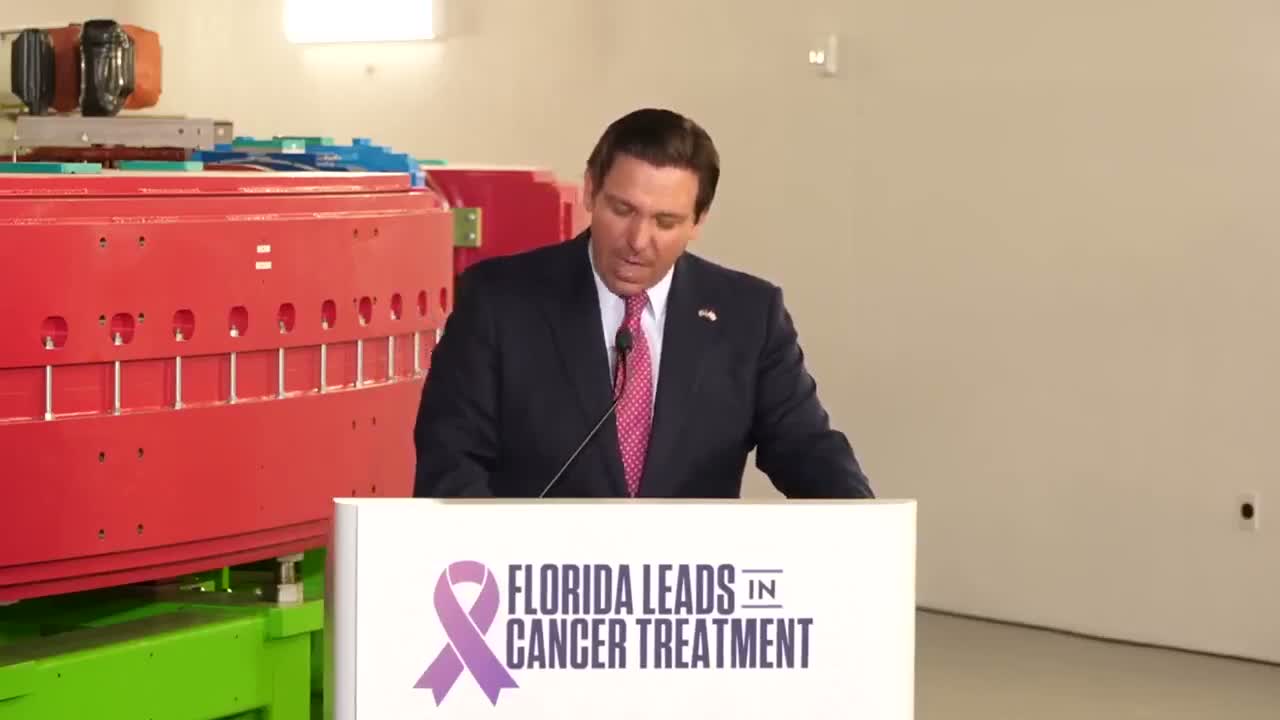
Summary
Mayo Clinic announced it is launching the first carbon‑ion therapy program in the United States at its Dwan Family Building in Jacksonville, with proton therapy expected in 2027 and carbon‑ion therapy in 2028; Governor DeSantis said Florida supplied tens of millions in support, pending FDA approvals.
Mayo Clinic officials and Florida Governor Ron DeSantis onstage at the Dwan Family Building in Jacksonville on a press day announced the health system’s plan to deploy heavy‑particle carbon‑ion therapy in the United States, saying the center will pair carbon‑ion and proton capabilities to treat cancers that are resistant to conventional radiation.
“Mayo Clinic is now launching the technology, for the first carbon ion therapy program. Anywhere, the first carbon ion therapy program anywhere in The United States Of America,” DeSantis said, adding that the site “will be the only carbon ion therapy program in the entire Western Hemisphere.”
Ken Thielen, speaking for Mayo Clinic, described the Dwan Family Building as “our new integrated oncology facility” that brings together photon, proton and the carbon‑ion system and said the campus is beginning a “rigorous calibration process to ready the system for our future patient treatments.” He said the accelerator is “larger than a football field” and will permit highly precise delivery of heavy particles to target tumors while sparing nearby healthy tissue.
Mayo and state officials gave a projected schedule: “We anticipate treating first patients with proton therapy in early 20 27, and as the governor shared, carbon therapy in the months ensuing,” Thielen said. DeSantis reiterated the timelines, saying proton therapy will begin in 2027 and carbon‑ion therapy in 2028, but added that some aspects of the carbon‑ion program require work with the U.S. Food and Drug Administration before patient treatment can begin.
On funding, DeSantis said the overall project is “at least $330,000,000” and that the state contributed roughly in the range of $30 million to $50 million depending on accounting. He also said Mayo Clinic has received nearly $100 million from state cancer initiatives across programs. “About $30,000,000 of our program funds contributed, to where we are today,” he said.
Mayo officials and the governor framed the project as a step to expand options for patients with treatment‑resistant tumors and to reduce treatment burden. Thielen emphasized patient benefit and research opportunities the particle therapy platform may enable, including work to pair particle therapy with immunotherapy.
Next steps outlined at the announcement include the facility’s calibration and regulatory work with federal agencies; officials said those approvals are required before carbon‑ion treatments begin. The ceremony concluded with a ceremonial activation of the beamline and officials praising the collaboration between Mayo Clinic and state programs.
The announcement did not include a formal vote or contract text; officials identified the Casey DeSantis research program and state Innovation Fund among public programs that supported the effort but did not provide a complete funding breakdown in the remarks.