
Portland committee hears draft requiring officers to show identity; no vote as public testifies
Get AI-powered insights, summaries, and transcripts
Sign Up Free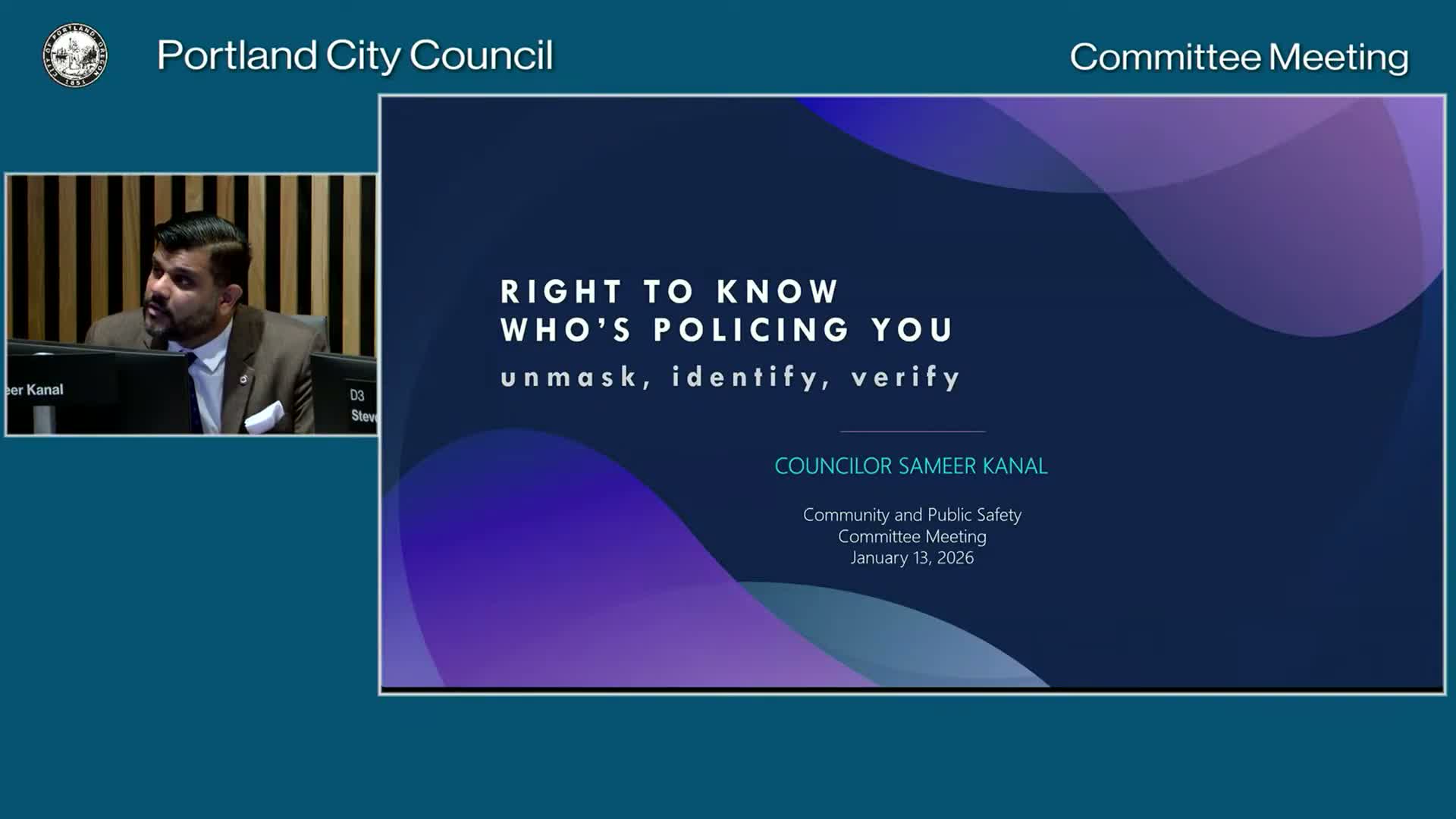
Summary
Councilors heard a public preview of a draft ordinance to limit mask use by law enforcement, require visible indicia of authority, verification steps, and documentation; city staff warned of legal, labor and cost constraints and no committee vote was taken today.
Portland — The Community and Public Safety Committee on Jan. 13 reviewed a draft ordinance intended to ensure Portlanders "have a right to know who’s policing you," but the panel took no vote and invited public feedback.
Councilor Sameer Kunal, who introduced the draft, described four core components — masking limits, visible identification, a verification process and documentation — and said the bill is an early "frontroom" draft meant to be shaped by council questions and community input. "This document is not the end of a backroom deal. It's the start of a frontroom deal," Kunal said.
The administration outlined operational hurdles. Bob Kazi, deputy city administrator for public safety, and Brian Hughes, assistant chief of the Portland Police Bureau, told the committee the city must follow federal law and existing oversight agreements. Hughes said federal law "supersedes local law," that the city cannot compel federal officers to unmask, and that some goals of the draft cannot be met when federal agents operate in the city.
Hughes also raised practical and cost concerns: he said new uniform and name-tag requirements would cost about $560,000 and take 18 months to two years to implement, and that added documentation requirements would increase workload without current staffing authorization. "The ordinance creates a permanent reporting requirement that will significantly increase administrative workload," he said, adding that certain provisions are likely mandatory subjects of bargaining with the Portland Police Association.
Kunal and other supporters framed the measure as a step to deter impersonation and undocumented enforcement actions. The draft splits verification into two parts, Kunal said: a voluntary agency contact when identity is unclear, and, "if and only if reasonable suspicion exists," a further investigation that may include a stop consistent with constitutional standards.
Public testimony filled the meeting: 49 people signed up, and speakers across successive panels described alleged incidents involving masked, unmarked officers and urged stronger action. Catherine Jimenez, one of the first speakers, cited national cases and said the ordinance is "the bare minimum for building back community trust." Several testifiers called for revoking the McAdam ICE facility permit and for additional tools for community reporting and enforcement.
City attorneys and police commanders told the committee they would continue refining the draft to address constitutional limits, mutual-aid reality and labor bargaining obligations. Chief deputy city attorney Heidi Brown said that "if provided there’s reasonable suspicion that a crime may have occurred, for example, a kidnapping, then you would treat it like any kidnapping," acknowledging limits imposed by supremacy and case law.
Kunal said the ordinance would not create criminal penalties for officers who fail to comply; instead it would require documentation and supervisor review. He emphasized the draft will be revised (version 7) to clarify language and operational effects before any formal filing for a future council vote.
The committee did not vote on the ordinance. Kunal said staff will continue to consult with stakeholders and invited people to submit evidence and examples; the committee’s next meeting is scheduled for Jan. 27, when other public-safety items will be considered.
Provenance: This article is based on the committee’s presentation and public testimony (topic introduction began at SEG 146; discussion and public comment continued through SEG 3060).