Get Full Government Meeting Transcripts, Videos, & Alerts Forever!
Get email alerts on the Utilities Finance topic
No spam. Unsubscribe anytime.
Palm Coast targets $280M utility bond issuance to fund five‑year water and wastewater plan
Summary
City staff outlined a plan to issue about $280 million in utility revenue bonds — part of a roughly $330 million financing package — to fund a five‑year capital improvement program that emphasizes water quality, wastewater capacity and grant‑funding efforts. Council pressed staff on grant performance, timelines and communications about water quality.
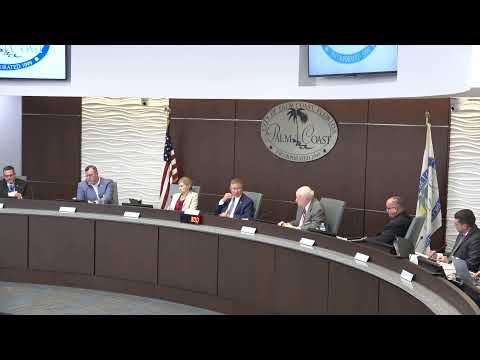
Palm Coast City Council workshop — City staff told the council on Jan. 13 that it plans to seek bond authorization next week and to sell utility system bonds in March–April 2026 to fund a multi‑year water and wastewater capital program.
Helena Alks, finance director, introduced Joel Bridal of Hilltop Securities, who described the financing plan as a combination of new‑money borrowing to support projects and a potential refunding of earlier taxable bonds. Bridal said the issuance was initially sized by the council’s earlier rate action and that ‘‘the proposed issuance is expected to be repaid over approximately 30 years’’ and that, as of Jan. 5, total sources/uses were anticipated at about $330,000,000 with roughly $283,000,000 of project proceeds.
Why it matters: The financing will underpin a large infrastructure program that officials say is needed to improve water quality, expand wastewater capacity and meet regulatory obligations. Bridal estimated a blended all‑in true interest cost near 4.44 percent and said combining the refunding with new money could produce about $1.7 million in present‑value savings (roughly 3.4 percent of refunded par) under market conditions observed on Jan. 5.
What staff presented: Brian (last name not specified in the transcript), who led the capital plan presentation, outlined a five‑year CIP of about $590,000,000 total and said roughly 15 projects represented about $450,000,000 of that program. He described the system: three treatment plants of differing vintages, 67 production wells, more than 800 miles of water mains and some 57,000 customer accounts; major items included Wastewater Plant 1 expansion, transmission mains and meter replacement work.
Brackish water and master planning: Brian said a water master‑plan RFP will be issued soon and that Water Plants 2 and 3 are membrane‑type plants capable of treating brackish supply; he cautioned that brackish treatment is more expensive than freshwater but may be needed as part of a diversified supply strategy.
Grants, procurement and execution: Staff said they are pursuing SRF loans and grant opportunities and have recently expanded procurement options to hire technical consultants for short work scopes (under $35,000) to prepare project definitions that make grant applications competitive. Brian and councilmembers emphasized the need for stronger grant performance; one councilmember said the utility department has had ‘‘a failure to get grants’’ and asked staff to ensure the funded grant‑writer position and outside consultants are used aggressively.
Council questions and public concerns: Council members pressed for clarity about how refinancing affects rates and operational budgets; Bridal said refunding would lower expense by about $188,000 per year for the next 11 years under Jan. 5 market assumptions. Multiple councilmembers also raised public concern about periodic discoloration of tap water. A councilmember acknowledged that while the water meets primary safety standards, ‘‘the discoloration of it allows a narrative’’ raising public concern and asked staff to improve communications. Brian estimated some improvements could be evident in 18 months with major investments taking 3–5 years and noted the CIP includes targeted water quality projects (a ~$50 million sustainability program for Water Plant 1 and other R&R projects).
Next steps and authorization: Bridal said staff will present an authorizing bond resolution to council on Jan. 20 that would delegate parameters for the financing; staff indicated market execution and closing were preliminarily anticipated for March–April 2026. Council and staff agreed to continue refining project definitions, pursue grants, and present routine operational reporting and financial metrics (debt service coverage, liquidity and debt‑to‑asset ratios) as the program advances.
What’s next: The council will consider the authorizing resolution on Jan. 20. If approved and market conditions are favorable, staff expects to go to market in March–April 2026 and close the bond sale within a few weeks of pricing.