
Senate approves FY2026 budget bill amid objections over casino back pay and added positions
Get AI-powered insights, summaries, and transcripts
Subscribe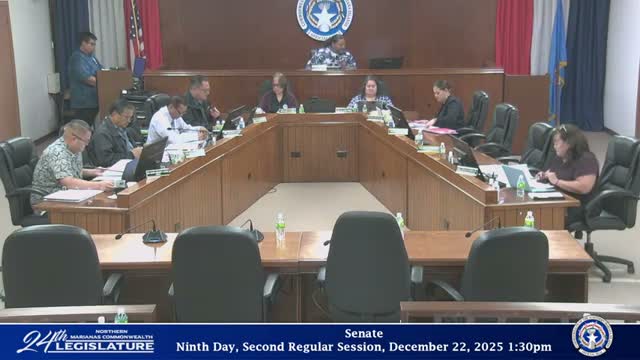
Summary
On Dec. 22, 2025, the Northern Mariana Islands Senate passed House Bill 24-80 HS1, the FY2026 budget, after hearings on resource estimates and safeguards; the final vote was 7–1 with one member absent amid objections to a provision authorizing back pay for casino commissioners.
The Commonwealth Senate on Monday passed House Bill 24-80 HS1, the fiscal year 2026 budget measure, after debate over revenue estimates, earmarks and a contested provision that would authorize back pay for casino commissioners. The bill passed on a 7–1 roll-call vote with one member absent.
Fiscal analyst Dave Demapan laid out the administration-identified starting point for the budget at approximately $158,000,000 and described additional Department of Public Lands resources of about $4.4 million. After earmark reservations, debt-service obligations and a reinstatement to avoid charging the first quarter, Demapan said net available general-fund resources are roughly $130.9 million. “Let me begin with the identified resources by the governor, of approximately $158,000,000,” he said while walking members through the calculations.
The bill includes earmarks and reservations for specific obligations: approximately $3.5 million for designated earmarks, several debt-service reserves (including bond and interim financing obligations), and provisions intended to protect retirees and certain federally funded positions. Committee leaders emphasized provisions to reserve 25% pension payments for retirees and to require monthly reporting with the administration to track projected receipts and any excess funding.
Several senators praised the compromise reached between the House and Senate. Senator Hauschneider, chair of Fiscal Affairs, said the package “prioritizes” continuation of group health and life insurance coverage and memorializes recognition of a $29 million minimum annual payment tied to existing loan terms. He described the work as an effort to provide a workable product that the administration can accept and implement.
A vocal objection came from Senator Babolta, who said adding three new positions for a municipality and including a back-pay provision for casino commissioners under section 6-15 was improper. Citing prior legal guidance, he argued the payment would use public funds to compensate non-government employees and said the attorney general had determined the payment to be illegal. “Using public funds to compensate non government employees violates the law,” he said, and announced he would dissent to the bill as drafted.
The presiding officer acknowledged the time pressures under which the legislature worked, noting loan terms and related documentation arrived only in early December, and urged members to forward the approved budget to the governor so the Department of Finance can begin implementation and negotiations for health coverage.
House Bill 24-80 HS1 passed the Senate by recorded vote (7 yes, 1 no, 1 absent) and will be transmitted to the governor for signature or other action. The Senate also directed ongoing oversight through required reporting provisions and monthly engagements with the administration to monitor revenues and expenditures.
The Senate adjourned at 6:52 p.m.