
Shore Regional Health outlines AHEAD model, federal rural funds, and regional medical center progress
Get AI-powered insights, summaries, and transcripts
Sign Up Free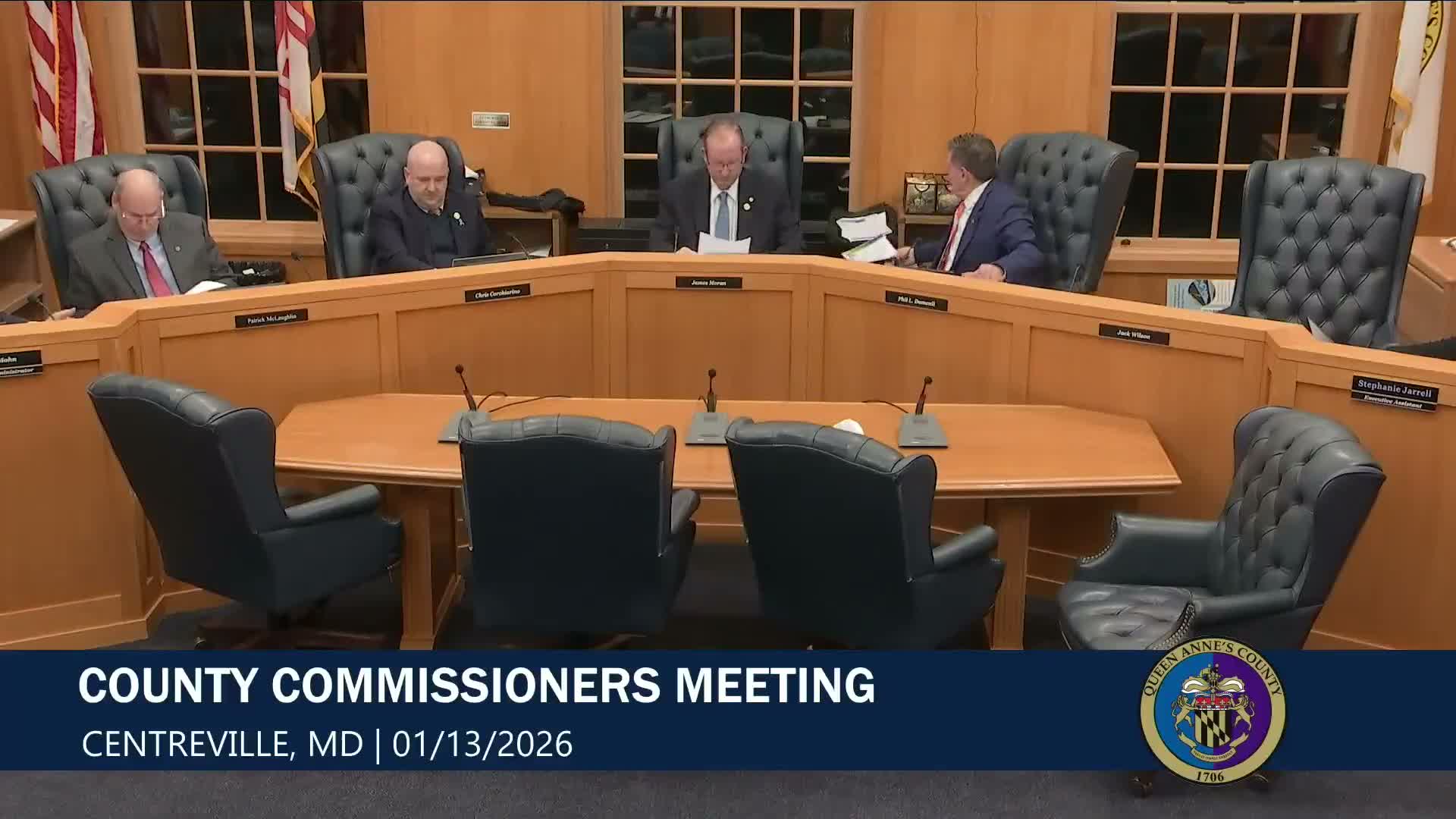
Summary
University of Maryland Shore Regional Health officials briefed commissioners on national rural hospital challenges, Maryland's new 10-year AHEAD waiver (effective 2026–2035), a $168 million CMS allocation to Maryland from the federal rural transformation program, and construction updates for the Midshore regional medical center (147 beds, geothermal systems planned).
University of Maryland Shore Regional Health leaders told the Queen Anne's County commissioners on Jan. 13 that rural hospitals nationwide face financial pressure and that several policy and funding developments offer opportunities for the Midshore region.
Ken Kozell, president of Shore Regional Health, said Maryland’s new 10-year waiver, known locally as the AHEAD model (Achieving Health Care Efficiency through Accountable Design), was signed by the state and CMS and takes effect Jan. 1, 2026. He described the model’s goals as curbing health-care cost growth, improving population health and strengthening primary care and community connections. Kozell said the state also secured federal Rural Health Transformation funds; he reported Maryland would receive an initial $168,000,000 allocation from that federal program.
Kozell and Laura Wilson, director of external affairs and community liaison, described the system’s Midshore service area as roughly 172,000 residents across five counties, with about 54% of that population on Medicare or Medicaid. They provided construction updates for the new regional medical center: the project site is advancing, geothermal wells are being drilled (presented as 1,728 wells on a 40-acre parcel, 400 feet deep) and the structure was reported to be rising, with the second floor foundation being placed. Kozell said the facility is licensed for 147 beds under the state certificate-of-need process (compared with 118 beds licensed at the current facility), and that rooms will be private and telemetry-capable.
On workforce, Kozell cited partnerships with Chesapeake College and a plan with the University of Maryland School of Medicine to reserve 10 additional medical school slots for students who commit to rural medicine, creating a multi-year pipeline. Wilson highlighted local patient volumes and service statistics (fiscal year ’25): about 7,524 admissions, ~71,000 ED visits and ~45,000 urgent care visits across the five-county region; Kent Island urgent care reported 15,625 visits and the freestanding emergency department 17,688 visits.
Commissioners asked detailed questions about behavioral health capacity, inpatient and outpatient gaps for children and adolescents, potential capital costs for upgrades and sustainability of programs funded through short-term federal grants. Kozell responded that behavioral health assessments are underway, that some inpatient capacity may exist elsewhere on the Eastern Shore, and that some outpatient expansions would be lower-cost but staffing remains a central constraint. He and Wilson said they intend to seek federal and state grant funding (including from Maryland’s allocation of Rural Health Transformation funds) to support workforce, technology and community-based services.
The presentation closed with commissioners thanking the presenters and noting ongoing county support for the regional hospital project.